Voice AI for sales intelligence platforms: How to use AI in 2025
Learn how a Voice AI system can improve your sales intelligence platform.


Here's a number that should get your attention: sustained AI investment correlates with roughly a 20% difference in sales growth between firms that commit and firms that don't. That gap doesn't come from buying more CRM seats. It comes from doing something with the conversations your reps are already having every single day—calls, demos, discovery, negotiation—that otherwise evaporate the second someone hangs up.
That's the gap Voice AI closes for sales intelligence platforms. You're sitting on thousands of hours of audio that contain exactly which objections killed which deals, which talk tracks closed them, and which competitor got name-dropped on the call that went dark. The hard part was never collecting the audio. It was turning it into something queryable, scoreable, and routable back into the workflow.
So let's talk about how to actually build that. Not in the abstract—what's working in production right now, which models do what, and where the real engineering decisions live.
What sales intelligence platforms do with Voice AI
Strip away the marketing and a sales intelligence platform is doing one thing: converting spoken conversation into structured data your customers can act on. The pipeline is transcription, then speaker attribution, then understanding—sentiment, topics, entities, summaries—then whatever LLM-powered layer turns all of that into a coaching note, a CRM field, or a real-time nudge.
The reason this is finally worth building on top of (instead of building yourself) is accuracy. When conversation intelligence systems miss a competitor mention or mangle a pricing number, the insight is worse than useless—it's misleading. The difference between transcribing "we need to discuss pricing" and "we need to dismiss pricing" is the difference between a follow-up and a lost quarter.
The thing is, the use cases that move revenue have shifted. A year ago most of this was post-call analysis. Now the most valuable workloads are happening live, or close to it.
Start with what's working now
Lead qualification is the clearest win. Reps spend a brutal amount of time on calls that were never going to convert. With real-time transcription and topic detection running on the live stream, you can score intent as the conversation unfolds—flag the budget-confirmed, timeline-urgent prospects and let your platform route them up the priority list before the call even ends.
Appointment setting and inbound triage follow the same pattern. A streaming model transcribing at sub-300ms latency means your platform can detect "yes, book the demo" and fire the calendar action mid-sentence, not in a batch job three minutes later.
Real-time coaching is the one sales managers actually beg for. They can't sit in on every call, but your platform can. Stream the audio, run sentiment and key-phrase detection against it, and surface a quiet prompt when a rep skips the discovery question that correlates with closed-won, or when a prospect's tone curdles after the price reveal. That's coaching at the scale of every rep on every call, not the three calls a manager had time to shadow this week.
And then there are AI voice agents doing cold outreach. This is no longer a demo-stage curiosity—platforms are shipping outbound agents that qualify, handle basic objections, and book meetings, then hand warm leads to humans. More on how to actually build one of those in a minute.
Post-call analysis still matters, obviously. CRM enrichment, deal-risk scoring, win/loss pattern mining—that's the foundation. But the frontier moved to live, and the platforms winning right now are the ones that figured out the real-time layer.
The core models, and where each one earns its keep
Four capabilities do most of the work. Here's how they map to actual product features.
Async and real-time transcription
You need both, and they're different jobs.
Async is for recorded calls—the post-mortem, the coaching review, the bulk reprocessing of your back catalog. AssemblyAI's speech-to-text async API runs on the Universal-3 family, and you pass the models you want explicitly: speech_models=["universal-3-pro","universal-2"]. Universal-3 Pro covers the high-accuracy English-and-core-language path with access to 99 languages when you've got a global sales floor. The singular speech_model parameter is deprecated, so use the array.
Real-time is the live stuff—coaching prompts, intent scoring, compliance flags as words land. You connect to wss://streaming.assemblyai.com/v3/ws, the latest streaming model returns partials under 300ms, and value tiers start at $0.15/hr. One detail that bites teams in production: streaming is billed per session duration, so close your sessions explicitly when a call ends. If you don't, there's a 3-hour auto-close, but you do not want to be paying for three hours of silence per abandoned socket.
Speaker diarization
Turn it on with speaker_labels: true and your transcript stops being a wall of text and starts being a conversation you can analyze. Talk-to-listen ratio is one of the most predictive coaching metrics there is—reps who talk 70% of a discovery call close less—and you can't compute it without knowing who said what. If you want the deeper mechanics, here's a good primer on how speaker diarization works.
Sentiment analysis
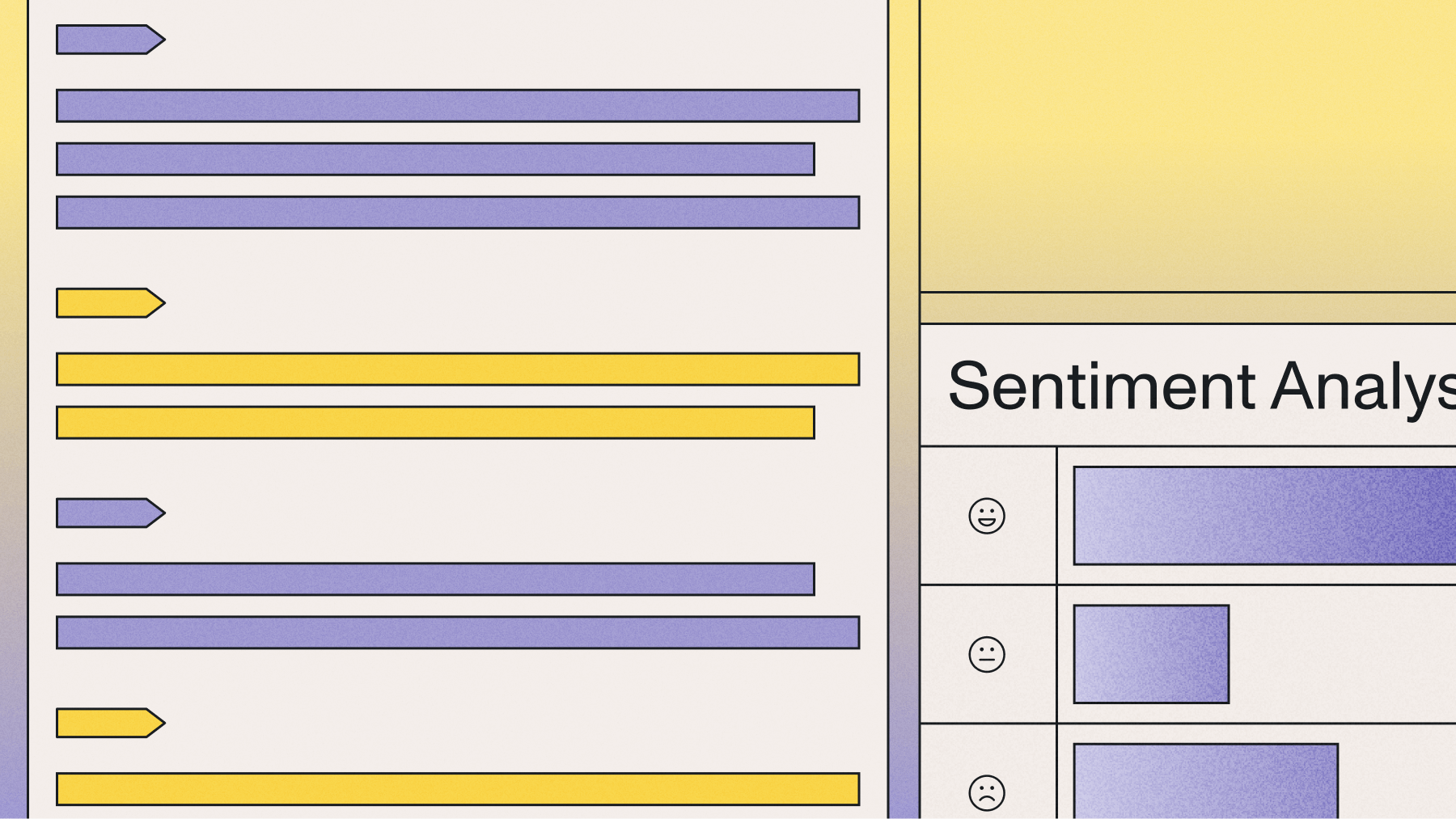
Sentiment analysis is what catches the moment a prospect goes from "tell me more" to politely checked-out. Track the shift across a call and you can pinpoint the exact segment where momentum died—usually pricing, sometimes a feature gap, occasionally a rep talking over an objection. Aggregate it across thousands of calls and you've got a heat map of where your customers' deals consistently stall.
LLM-powered insight
This is where raw transcript becomes a coaching note or a CRM field. Send the transcript to the LLM Gateway—POST https://llm-gateway.assemblyai.com/v1/chat/completions with a model like claude-sonnet-4-5—and you get summaries, extracted action items, deal-risk assessments, or answers to a structured prompt, all in one billing relationship instead of standing up a separate LLM vendor. Ask it "what objections came up and how did the rep handle each one?" and route the structured answer straight into your scorecard.
What this actually delivers
Jiminny is the case study worth knowing. It's a conversation intelligence and coaching platform, and it uses AssemblyAI's models for transcription, speaker identification, sentiment analysis, and action item extraction. The outcome its customers see: 15% higher win rates. That's not a transcription-accuracy metric—it's a revenue metric, which is the only kind that survives a budget review.
The broader pattern holds across the category. Over 70% of companies in recent industry research reported a measurable lift in end-user satisfaction after adding conversation intelligence, and 69% reported improved customer service. The mechanism is boring and reliable: you make the best rep's behavior legible, then make it learnable for everyone else.
How to build an AI cold-calling agent
This is the question I get most, so let's be concrete. A cold-calling agent needs three things working together in real time: it has to hear the prospect, decide what to say, and say it back—fast enough that nobody feels the lag.
You've got two ways to wire that up.
The build-it-yourself route: stream call audio into the real-time speech-to-text endpoint, pass each finalized utterance to an LLM through the LLM Gateway to decide the next line, then hand that text to a TTS engine and pipe the audio back to the prospect. You own every piece, you tune every prompt, and you're responsible for stitching the latency budget together across three hops. Plenty of teams do exactly this when they need maximum control over the agent's logic.
The faster route is the Voice Agent API. It bundles speech-to-text, the LLM, and TTS behind a single WebSocket, runs around 1-second end-to-end latency, and bills at a flat $4.50/hr—so you're not assembling and load-testing three services to get a working agent. It's a cascading, orchestrated pipeline under the hood: STT to LLM to TTS, each best-in-class at its job, coordinated for you. (It is not a single speech-to-speech model, and that distinction matters when you're reasoning about where you can inject business logic—you get to intercept at the text layer between transcription and generation, which is exactly where you want to enforce your qualification script and objection-handling rules.)
For an outbound qualification agent, the orchestrated approach is almost always the right call. You want to drop in your own LLM prompt for the sales logic, keep humans in the loop for handoff, and not spend a sprint debugging audio-buffer timing. Start there; drop to the build-your-own path only if you hit a wall the bundle can't clear.
Where the integration work actually lives
The models are the easy part now. The engineering reality is in three places.
Security and compliance. Sales calls are full of PII, and regulation has become the top barrier to AI deployment in enterprise surveys. Turn on PII redaction so phone numbers, card data, and the like get stripped before anything hits storage or an LLM. If your customers operate in healthcare-adjacent markets, note that AssemblyAI is a business associate under HIPAA and offers a Business Associate Addendum (BAA) for customers processing PHI—a BAA is available when you need one.
Accuracy in the wild. Home offices, hold music, cell connections, thirty different accents on a global team. This is where model quality stops being a benchmark line and starts being a support-ticket count. Models trained on diverse real-world audio hold up; ones tuned on clean read-speech fall apart on a Tuesday-afternoon discovery call.
Scale and cost. Whether you're processing hundreds of hours or millions, the bill and the latency should stay predictable. Usage-based pricing with no concurrency caps means a viral month doesn't become a rearchitecture project. Model-specific rates start at $X/hr (see assemblyai.com/pricing).
AssemblyAI vs. Deepgram, factually
You'll evaluate both, so here's the honest framing. Deepgram is a capable speech-to-text provider with low-latency streaming and competitive async pricing; plenty of teams ship on it. Where the decision usually turns for conversation intelligence specifically is the layer above raw transcription—whether sentiment, topic detection, entity detection, summarization, and an integrated LLM path come from one provider or get assembled from several.
AssemblyAI's pitch is that the speech understanding features and the LLM Gateway sit on the same API as transcription, so you're not gluing four vendors together to score a call. Run both on your own audio—your accents, your jargon, your call quality—and let the word error rate and the downstream feature fit decide. Benchmarks are a starting point; your data is the tiebreaker.
Don't just transcribe—route the insight
The platforms pulling ahead aren't the ones with the cleanest transcripts. They're the ones that took the structured output—the sentiment shift, the detected objection, the extracted action item—and wired it directly into the place a human takes action: the CRM record, the manager's coaching queue, the next rep's pre-call brief. Transcription is table stakes now. The product is what you do with the seventh field the LLM hands back.
That's the build worth making this quarter. Your competitors are already evaluating it, and every call that goes through your platform un-analyzed is intelligence your customers paid for and never got.
Frequently asked questions
What is the best API for conversation intelligence and call analytics?
The best API for conversation intelligence is one that combines accurate transcription with built-in understanding features on a single platform. AssemblyAI pairs the Universal-3 family of speech-to-text models with speaker diarization, sentiment analysis, topic detection, entity detection, and summarization, plus an LLM Gateway for custom analysis—so you get call analytics end to end without stitching together multiple vendors. Evaluate it on your own call recordings, since accuracy on your specific audio matters more than any single benchmark.
How do I create an AI cold-calling agent?
You create an AI cold-calling agent by combining real-time speech-to-text, an LLM to decide responses, and text-to-speech to reply. The fastest path is the Voice Agent API, which bundles all three behind one WebSocket at roughly 1-second latency and a flat $4.50/hr, so you don't have to assemble and latency-test three separate services. You can still inject your own LLM prompt for qualification logic and objection handling, and keep a human in the loop for handoff.
AssemblyAI vs Deepgram: which is better for conversation intelligence?
Both are capable speech-to-text providers, so the right choice depends on your needs. Deepgram offers low-latency streaming and competitive pricing, while AssemblyAI bundles speech understanding features—sentiment, topic detection, entity detection, summarization—and an integrated LLM Gateway on the same API as transcription. For conversation intelligence specifically, having that analysis layer in one platform reduces integration work, but the reliable way to decide is to benchmark both on your own audio.
What insights can AssemblyAI extract from sales calls?
AssemblyAI can extract transcripts, speaker-attributed dialogue, sentiment shifts, topics, named entities, key phrases, summaries, and action items from sales calls. With speaker diarization you can compute talk-to-listen ratios and attribute statements to specific reps or prospects. Through the LLM Gateway, you can run custom prompts to surface objection handling, deal risk, competitor mentions, and coaching feedback tailored to your scorecard.
Can AssemblyAI integrate with CRM and contact center platforms?
Yes. AssemblyAI is API-first, so transcripts and extracted insights can be pushed into CRM records, sales engagement tools, and business intelligence systems through your own integration layer. It's commonly used inside contact center and sales platforms to enrich customer records with conversational data. Usage-based pricing with no concurrency caps means the same integration scales from hundreds to millions of hours of audio.
Lorem ipsum dolor sit amet, consectetur adipiscing elit, sed do eiusmod tempor incididunt ut labore et dolore magna aliqua. Ut enim ad minim veniam, quis nostrud exercitation ullamco laboris nisi ut aliquip ex ea commodo consequat. Duis aute irure dolor in reprehenderit in voluptate velit esse cillum dolore eu fugiat nulla pariatur.
Related posts