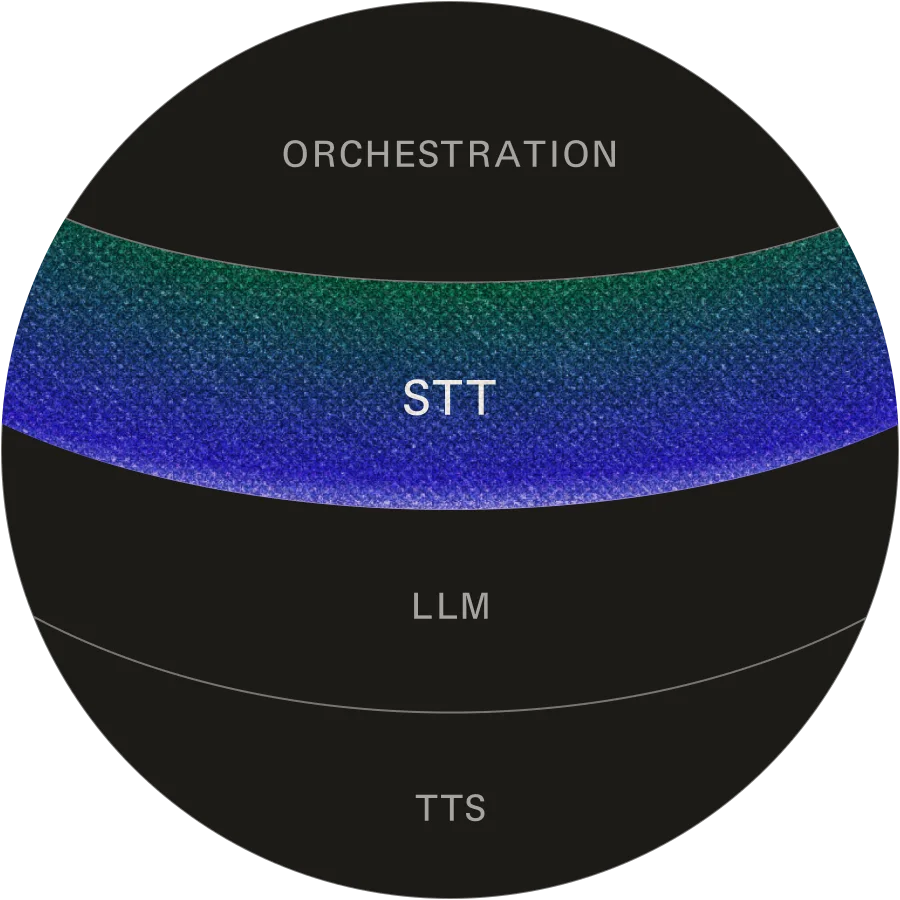

Ultra-fast and ultra-accurate streaming STT built for voice agents. Get 300ms immutable transcripts and intelligent endpointing so your agents feel more natural and finish tasks successfully.
Speak into your browser and watch your words appear in real time.
Try the Voice Agent API live. This support agent is built on the Voice Agent API — the same one you can ship with. Click to start talking and experience real-time Voice AI in action. Ask about our products, APIs, or docs.
Please note: This agent provides customer support for AssemblyAI products only. Do not share sensitive or non-public information.
“The speed difference is immediately noticeable — our users see their conversations transcribed almost instantaneously. It feels so much more responsive than what we were using before.”
Jonathan Kim,Software Engineer
Building a Voice Agent?
Voice Agent API
Stream audio in, get audio back. We handle the rest with our proprietary voice stack, so you can focus on your product.
Run your own VAD and turn detection? Send each finished utterance in one HTTP call and get a flagship-accuracy transcript back in ~134ms — no streaming session to manage.
It depends on how much of the stack you want to own. The Voice Agent API is a fully managed pipeline — one WebSocket handles STT, LLM, and TTS with ~1 second end-to-end latency, making it the fastest path from idea to production. Realtime Speech-to-Text API at $0.45 per hour gives you full architectural control: drop Universal-3.5 Pro Realtime into your existing orchestrator and bring your own LLM and TTS. Choose the Voice Agent API for speed and simplicity; choose Streaming STT when you need to customize every layer. A third option for the most sophisticated builds: if your orchestrator already handles VAD and turn detection, the Sync Speech-to-Text API transcribes each finished utterance in a single HTTP request (~134ms) — no streaming connection to manage at all.
Both the Voice Agent API and Realtime Speech-to-Text API offer pre-built integrations with LiveKit, Pipecat, Claude Code, Python SDK, Twilio SIP, and Nextup SDK. The Voice Agent API connects via any standard WebSocket client with no proprietary SDK required, while Streaming STT works natively with LiveKit Agents, Pipecat pipelines, and custom WebSocket architectures. Step-by-step integration docs are available for each framework so you can go live without disrupting existing workflows.
The Voice Agent API delivers ~1 second end-to-end latency (speech in to speech out) at a flat $4.50 per hour covering the full pipeline. Realtime Speech-to-Text API delivers transcript results in ~300ms at $0.45 per hour, billed on session duration — the time your WebSocket stays open, not audio duration. The Voice Agent API uses session-based flat-rate billing with no concurrency caps; Streaming STT also offers unlimited autoscaling concurrent streams. Both include a free tier to test before committing.
Yes. Both APIs share the same Universal-3.5 Pro speech recognition foundation, so transcription quality stays consistent regardless of which path you choose. Developers often prototype with the Voice Agent API for speed, then move individual components to Streaming STT as their architecture matures and they want more control over LLM routing or TTS selection. Since both use WebSocket connections and standard JSON, switching requires updating your connection endpoint and message handling — not rebuilding from scratch.
If you already use an orchestrator like LiveKit or Pipecat with your own LLM and TTS providers, Realtime Speech-to-Text API is the natural fit — it plugs directly into your pipeline as the STT layer with intelligent endpointing and immutable transcripts. If you're starting from scratch or want to replace a multi-vendor stack with a single API, the Voice Agent API eliminates integration complexity entirely. The solutions comparison table on the page above breaks down the differences across latency, architecture, pricing, and feature support to help you decide.