AI voice agents: what they are and how they work in 2026
AI voice agents are conversational systems that understand spoken language and respond with human-like speech to automate real conversations—answering calls, booking appointments, and resolving support end to end.



A few years ago, “talk to a computer and it actually understands you” was a demo. Now it’s a Tuesday. AI voice agents are answering support calls, booking appointments, qualifying leads, and taking payments — and the good ones are hard to tell apart from a person who’s having a good day.
AI voice agents are conversational AI systems that understand spoken language and respond with human-like speech to automate real conversations. They’re the reason a caller can say “yeah, actually, can you move that to next Thursday instead?” and the system just handles it — no menu, no “press 1,” no repeating yourself three times.
The market reflects the shift. Voice and speech recognition is projected to grow from around $14.8B in 2024 to more than $61B by 2033. But the interesting story isn’t the market size. It’s what finally made these agents good enough to trust with a live customer — and where they still fall over.
This guide covers what voice agents are, how they actually work under the hood, what they cost, and how to build one. And a quick note on where we sit in all this: AssemblyAI is invisible infrastructure. We’re not the agent. We’re the voice layer you build the agent on — the Voice Agent API and the streaming speech-to-text models underneath it. So when we say something is hard, it’s because we’ve watched a lot of teams hit the wall.
What is an AI voice agent?
An AI voice agent is a software system that holds a spoken conversation to complete a task. You talk, it understands, it does something useful, and it talks back — in real time, over the phone or through an app.
The key difference from the old interactive voice response (IVR) systems you've cursed at: voice agents replace rigid menu trees with natural dialogue. Traditional IVR routes you. A voice agent resolves you. It can pull up your account, check your order, reschedule the delivery, and confirm — all in one flowing conversation, and all without a human picking up.
Under the hood, that's an end-to-end flow: spoken input becomes text, text becomes understanding and action, and the response becomes speech again. Every link in that chain has to be fast and accurate, because callers notice the seams instantly.
How are AI voice agents different from traditional IVR?
How do AI voice agents work?
Most production voice agents run on three components chained together:
- Speech-to-text (STT/ASR): converts the caller’s audio into text as they speak. This is the foundation — if the transcription is wrong, everything downstream is answering the wrong question.
- Language understanding (LLM): interprets intent, decides what to do, calls tools or APIs, and drafts a reply.
- Text-to-speech (TTS): turns that reply back into natural, spoken audio.
Speed is everything. AssemblyAI’s Universal-3.5 Pro Realtime model returns streaming transcripts with immediate partial results, and — this is the part that matters most for conversation — it uses neural end-of-turn detection to decide when the caller has actually finished speaking.
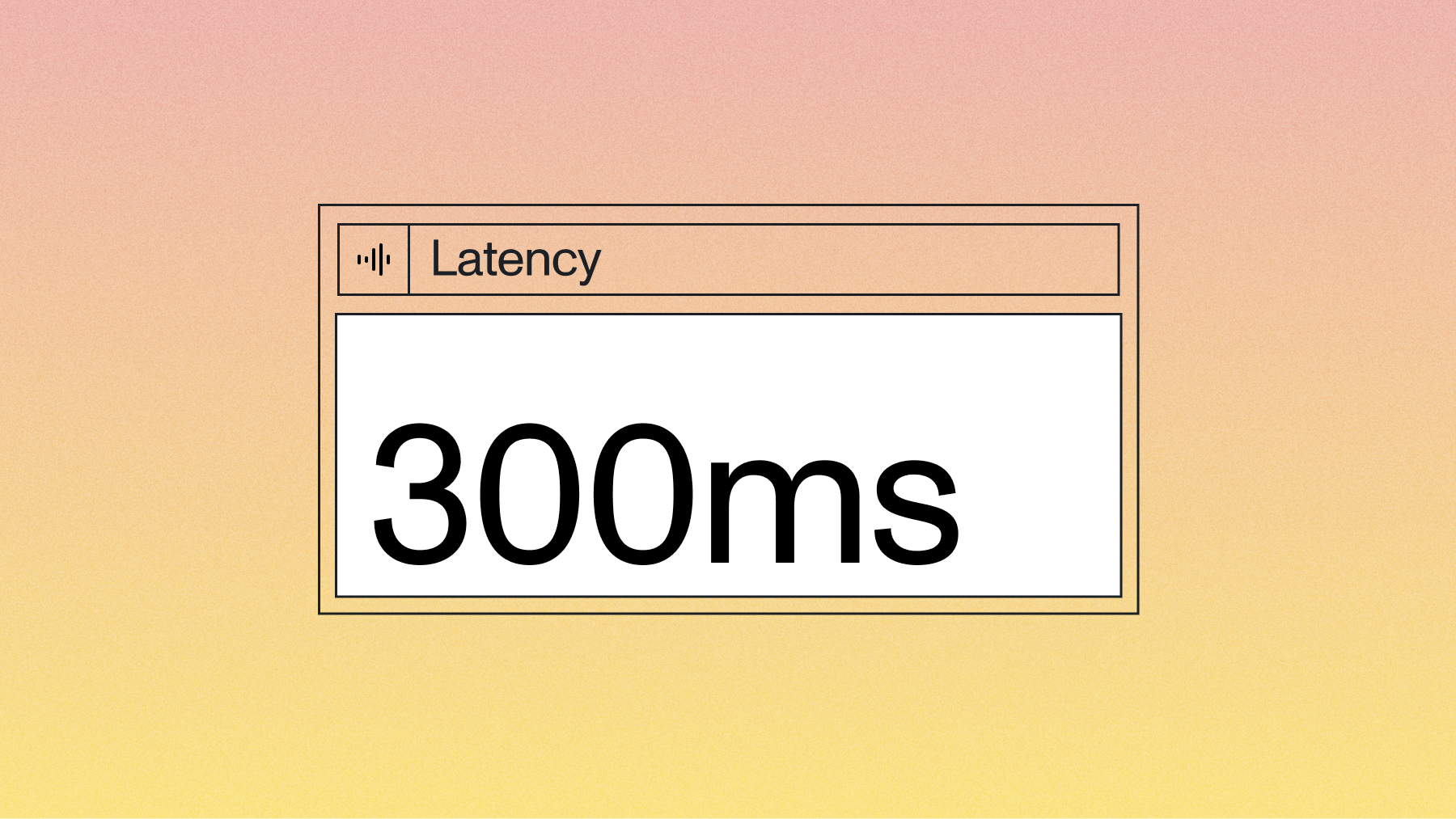
That’s a bigger deal than it sounds. Traditional voice activity detection (VAD) waits for silence. But people pause mid-thought. They say “my account number is... uh... 4 4 8...” and a silence-based system barges in and talks over them. Neural turn detection reads tonality and pacing — the human signals that mean “I’m still going” versus “your turn” — and lands an end-of-turn decision in roughly 300ms. Chain that with a fast LLM and TTS, and the whole round trip comes in around one second, which is about where a conversation stops feeling like a walkie-talkie.
The two ways to build: managed Voice Agent API vs. bring-your-own-stack
There are two honest paths to a production voice agent, and which one you pick mostly comes down to how much of the pipeline you want to own.
Path 1 (recommended): the Voice Agent API
The Voice Agent API collapses speech-to-text, LLM, and text-to-speech into a single WebSocket connection. Turn detection, interruption handling (“barge-in”), and voice activity detection are built in. You send audio, you get audio back, and you wire in your tools and prompts. It’s billed at a flat $4.50/hr per second of session — no juggling three vendors, three invoices, and three latency budgets.
This is the fastest route to something that actually works in production, and it’s the path we lead with. Most developers get a working agent running the same afternoon they start.
Path 2: bring your own stack on Universal-3.5 Pro Realtime
If you already have an LLM and TTS you love — or you’re building on an orchestration framework — you can bring your own stack and use Universal-3.5 Pro Realtime ($0.45/hr base) as your streaming speech-to-text layer. You get the same accuracy and neural turn detection; you just own the orchestration. This is the common pattern for teams on LiveKit or Pipecat, where we ship drop-in plugins rather than compete.
Either way, the STT layer is the same foundation. Which brings us to the part everyone underestimates: accuracy.
Benchmark callout — voice-agent streaming WER (Pipecat open STT benchmark, real agent conversations):
- Universal-3.5 Pro Realtime: 6.99% WER
- Google Chirp3: 9.04%
- ElevenLabs Scribe v2: 9.76%
- Deepgram Flux: 15.58%
On entity error rate — the names, phone numbers, and account codes that break a call when they’re wrong — Universal-3.5 Pro Realtime hits 15.31% versus Deepgram’s 50.5%, ElevenLabs’ 39.7%, and Google’s 21.51%. See the full benchmarks.
Why obsess over entity accuracy? Because a voice agent that hears "my card ends in 4152" as "4155" doesn't have a minor error. It has a failed transaction and an angry customer. General WER hides that; entity error rate is where voice agents live or die.
What are the main voice agent architectures?
Three patterns show up in production:
- Cascading: separate STT → LLM → TTS stages. Most modular, easiest to debug, and the architecture behind the vast majority of production agents. You can swap any component and inspect the text at every step.
- End-to-end (speech-to-speech): a single model takes audio in and emits audio out. Lower theoretical latency, but you lose the text you need for logging, compliance, tool calls, and debugging — and you're locked into one vendor's accuracy for every step.
- Hybrid: mostly cascading, with tighter coupling between stages to shave latency.
The trade-off is modularity versus latency versus control. Most teams shipping real workloads choose cascading, because when something goes wrong at 2am you want to see the transcript.
Conversational AI voice agents: what makes a conversation actually feel human
"Voice agent" and "conversational AI voice agent" get used interchangeably, but the second phrase is really about a bar: can the system hold a natural, multi-turn conversation, or does it just answer one question and reset?
A genuinely conversational AI voice agent has to do a few hard things at once:
- Handle interruptions gracefully. When a caller cuts in with "no, the other one," the agent needs to stop talking, listen, and adjust — not finish its scripted sentence.
- Know when a turn is actually over. This is the neural turn-detection problem again. Silence isn't the same as "done." Reading pacing and tonality is what separates a conversation from an awkward standoff.
- Keep context across turns. If you said your name three turns ago, the agent shouldn't ask again.
- Get the details exactly right. Emails, dates, dollar amounts, confirmation numbers — the stuff entity accuracy protects.
This is why the STT layer matters more for conversational agents than almost anywhere else. It’s not transcribing a podcast where a later editor fixes typos. It’s feeding a live decision, in real time, where a wrong word changes the answer. Teams building serious conversational agents — Retell, LiveKit, and Fireflies among the early adopters of Universal-3.5 Pro Realtime — start from accuracy and turn-taking and work outward.
What's the ROI of an AI voice agent?
The returns cluster in three areas:
- Operational efficiency: agents handle high-volume, repetitive calls around the clock without staffing for peaks. McKinsey has measured 30–45% productivity gains in customer care from applied AI.
- Customer experience: no hold music, no menu maze, instant answers. Workflow automation has been tied to roughly a 7% lift in customer satisfaction.
- Scalability: in published case studies, AI agents resolve up to 77% of L1–L2 support contacts, freeing humans for the genuinely hard cases.
First-year ROI improvements in the 30–200% range are realistic when the use case is chosen well. A Salesforce survey pegged a 37% ROI in customer-service departments deploying AI agents. The teams that hit those numbers don't boil the ocean — they pick one high-friction, high-volume workflow and nail it.
What are AI voice agents used for?
The common thread: narrow, well-defined tasks where the payoff is measurable. Broad "do anything" agents are where projects stall.
How do you build an AI voice agent?
Six steps that separate the demos from the deployments:
- Define a narrow use case with success metrics. “Handle appointment rescheduling for the clinic” beats “be a helpful assistant.” Decide what success looks like before you write code.
- Choose your platform and models. Managed API (the Voice Agent API, flat $4.50/hr) for speed, or an orchestration framework (Vapi, LiveKit, Pipecat) on Universal-3.5 Pro Realtime if you want to own the stack.
- Design conversation flows. Map the happy path, the edge cases, and — most importantly — the escalation path to a human.
- Add integrations and test with real users. Wire in your CRM, calendar, and payment tools. Then test on real accents, real background noise, and real messy speech.
- Deploy gradually. Internal → small customer segment → full rollout. Watch it before you trust it.
- Monitor the metrics that matter. Completion rate, escalation rate, handling time, and satisfaction. Iterate on the transcripts.
If you want a code-level walkthrough, our guide to building with the Voice Agent API takes you from zero to a working agent, and there’s a reason the API is designed to work cleanly with coding agents like Claude Code — one WebSocket, no SDK required.
How much does an AI voice agent cost?
Cost callout vs. OpenAI Realtime: The Voice Agent API's flat ~$4.50/hr comes in roughly 4x cheaper than OpenAI's Realtime API at about $18/hr — and because it's cascading, you get a dedicated best-in-class model at each step (STT, LLM, TTS) plus stronger neural turn detection, rather than one model doing everything at once.
For a deeper breakdown, see our guide on speech recognition cost and when it makes sense to switch providers.
What are the legal and compliance considerations?
Two things dominate: consent and data privacy.
Consent and disclosure. A 2024 FCC ruling confirmed AI-generated voices count as "artificial or pre-recorded" under the TCPA, which means marketing calls need prior express consent. Build disclosure into your flows.
Data privacy. SOC 2 Type 2 is the baseline enterprises expect. For healthcare specifically, here’s the accurate framing on PHI: AssemblyAI enables covered entities and their business associates subject to HIPAA to use the AssemblyAI services to process protected health information (PHI). AssemblyAI is considered a business associate under HIPAA, and we offer a Business Associate Addendum (BAA) that is required under HIPAA to ensure that AssemblyAI appropriately safeguards PHI. If you’re building agents for healthcare, that BAA is the mechanism that lets you handle patient data properly.
The future of AI voice agents
By 2024, roughly 66% of businesses had automated at least one process, and voice is fast becoming one of them. But the direction that actually matters isn't "replace all the humans." The agents that win augment people — they absorb the repetitive volume so human reps handle the calls that need judgment, empathy, or a hard decision.
The teams pulling ahead in 2026 aren't the ones with the flashiest demo. They're the ones who picked one high-friction use case, held the STT layer to a real accuracy bar, and measured the ROI. The technology is finally good enough. The differentiator now is discipline — and the quality of the invisible infrastructure underneath.
Try it yourself
The fastest way to understand a voice agent is to talk to one. Talk to our live Voice Agent API demo and hear the neural turn detection and entity accuracy in a real conversation.
Ready to build? Get your free API key — free API credit to start, no credit card required — and ship your first agent this afternoon.
Frequently asked questions
What is an AI voice agent, and how is it different from a chatbot or IVR system?
An AI voice agent is a conversational AI system that handles multi-turn spoken conversations through a speech-to-text, LLM, and text-to-speech pipeline. Unlike a rigid IVR menu, it understands natural speech and resolves tasks end to end rather than just routing calls.
How do AI voice agents work technically, from the moment a caller speaks?
Audio streams into a speech-to-text model that transcribes it in real time, an LLM interprets intent and calls any needed tools, and a text-to-speech model speaks the reply. Neural turn detection decides when the caller has finished, keeping the full round trip near one second.
How much does it cost to build and run an AI voice agent in 2026?
Assembling separate STT, LLM, and TTS vendors typically runs $0.01–$0.05 per minute. A bundled option like the Voice Agent API is a flat $4.50/hr billed per second — roughly 4x cheaper than OpenAI's Realtime API at about $18/hr.
What is the best speech-to-text model for a real-time conversational voice agent?
You want low latency, strong neural turn detection, and high entity accuracy. Universal-3.5 Pro Realtime posts 6.99% WER on the Pipecat voice-agent benchmark and a 15.31% entity error rate versus Deepgram's 50.5%, with sub-second end-to-end responsiveness.
Do I need a team of AI experts to build an AI voice agent?
No. Modern APIs abstract the hard parts. A general developer can ship a working agent on the Voice Agent API — one WebSocket, no SDK required — the same day they start, or use an orchestration framework if they want more control.
Are AI voice agent phone calls legal, and what about healthcare data?
Yes, with conditions: marketing calls need consent under TCPA rules, and AI voices count as artificial or pre-recorded. For healthcare, AssemblyAI is a business associate under HIPAA and offers a Business Associate Addendum (BAA) so covered entities can process PHI appropriately.
Lorem ipsum dolor sit amet, consectetur adipiscing elit, sed do eiusmod tempor incididunt ut labore et dolore magna aliqua. Ut enim ad minim veniam, quis nostrud exercitation ullamco laboris nisi ut aliquip ex ea commodo consequat. Duis aute irure dolor in reprehenderit in voluptate velit esse cillum dolore eu fugiat nulla pariatur.
Related posts