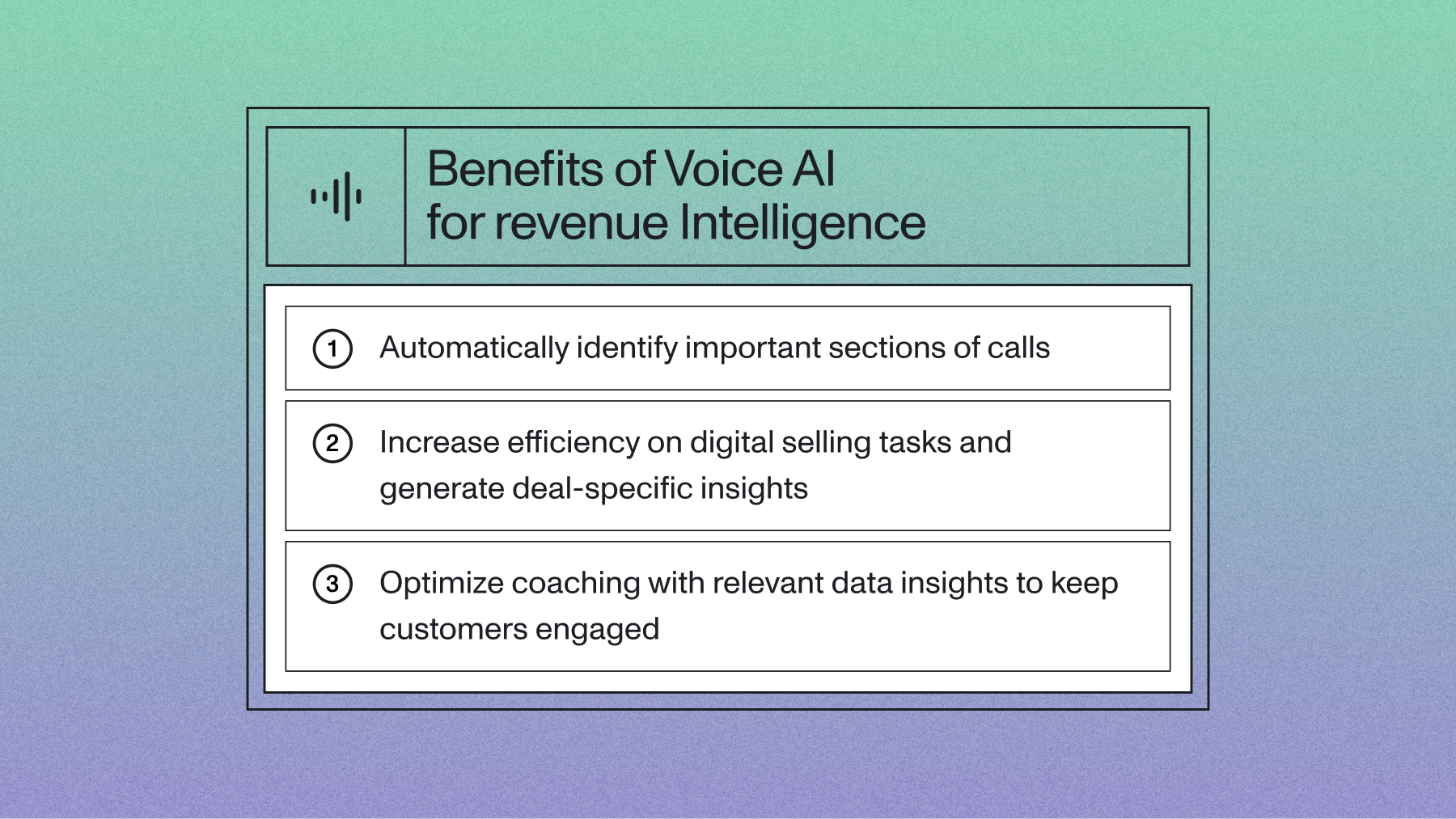
Revenue intelligence Platforms also need tools that can efficiently synthesize data to generate actionable, deal-specific insights for sales teams. Tools built with AI models such as Entity Detection, Summarization, and Sentiment Analysis can be used to generate real-time data for strategic analytics, which can then be leveraged by users to better identify and score winnable deals.
Entity Detection models can be used to build Revenue intelligence tools that automatically sort through a transcription text to uncover gaps in the sales process, identify trends, and turn this data into actionable insights.
Similar to what is described above, Summarization models can also help facilitate a smarter sales process by helping teams identify trends in conversations.
Sentiment Analysis can provide an overview of attitudes toward products, events, or even specific sales representatives.
Finally, revenue intelligence platforms should also build tools that help optimize a sales team's performance and boost customer engagement, a key benefit supported by industry survey data which shows 69% of companies report improved customer service after implementing such tools.
Summarization, Topic Detection, Sentiment Analysis, Entity Detection models, as well as LLMs, can be used together to build products that help sales teams better understand the true impact of every sales conversation.
Do customers respond better to certain topics or entities? Do certain agents have more success employing positive or neutral sentiments? Speech Understanding models can be used to build tools that unlock this insight for users in close-to-real time. This data can be analyzed and aggregated by additional revenue intelligence tools to inform whether to replicate and scale the successful behaviors or refocus and retrain on the less successful ones.
The most successful revenue intelligence implementations start with a foundation of highly accurate voice data. Companies across industries are discovering that the quality of their Voice AI directly impacts the value they can extract from their revenue intelligence platforms.
Leading revenue intelligence platforms like Clari rely on advanced Voice AI to power their conversation intelligence capabilities. By accurately transcribing and analyzing sales calls, these platforms help their users identify deal risks, track competitive mentions, and surface coaching opportunities that would otherwise remain hidden in hours of recorded calls.
Power your platform with enterprise-grade Voice AI
Join leading revenue intelligence teams using accurate transcription and speech understanding to reveal deal risks, trends, and coaching insights. Discuss scalability, security, and integrations with our experts.
Talk to AI expert
Companies like CallSource and Ringostat have built their entire revenue intelligence offerings around Voice AI, enabling sales teams to automatically capture every customer interaction and extract actionable insights. For these organizations, Voice AI isn't just a feature—it's the foundation that makes comprehensive revenue intelligence possible.
The pattern is clear across successful implementations: organizations that prioritize Voice AI accuracy see dramatically better results from their revenue intelligence investments. When transcription accuracy improves, so does the quality of every downstream insight—from sentiment analysis to deal scoring to coaching recommendations.
Leading implementations treat voice data as a strategic asset rather than archived files. Voice AI transforms every conversation into structured data that feeds revenue intelligence systems.
Voice data transformation delivers:
- Pattern identification across 10,000+ calls monthly
- Trend detection 60% faster than manual analysis
- Winning behavior replication across entire sales teams
Implementation strategies for Voice AI-powered revenue intelligence
Successfully integrating Voice AI into your revenue intelligence workflow requires a strategic approach that balances quick wins with long-term scalability. Most successful implementations achieve initial value within 2-4 weeks and full deployment in 8-12 weeks.
Implementation Phase | Timeline | Key Outcomes |
|---|
Basic transcription setup | 1-2 weeks | Automated call recording |
CRM integration | 2-4 weeks | Seamless data flow |
Advanced analytics | 6-8 weeks | Sentiment analysis, coaching insights |
Full deployment | 8-12 weeks | Complete revenue intelligence platform |
Start with accurate transcription as your foundation
Before any analysis can happen, you need highly accurate transcripts of every sales call and meeting. This transcription layer serves as the source of truth for all downstream insights. Poor transcription accuracy cascades through your entire system, undermining the value of even the most sophisticated analytics. For example, research on accuracy shows that a system with 85% accuracy produces three times as many errors as one with 95% accuracy, making transcripts difficult to read and corrupting downstream insights. Focus first on implementing Voice AI that can handle diverse accents, technical terminology, and real-world audio conditions.
Integrate seamlessly with existing systems
Your Voice AI solution should connect easily with your CRM, call recording systems, and other sales tools. This integration ensures that transcripts and insights appear where your sales team already works, eliminating the need to switch between platforms. Modern APIs make this integration straightforward, allowing you to pipe voice data directly into your existing revenue intelligence workflows.
Focus on high-impact features first
Begin by implementing capabilities that solve immediate pain points. Automated call summaries save reps hours of manual note-taking. Competitor mention detection alerts managers to competitive threats in real-time. Topic tracking reveals which messaging resonates with prospects. These quick wins demonstrate value immediately and build momentum for broader adoption.
Scale intelligently with advanced capabilities
Once your foundation is solid, expand to more sophisticated applications. Implement sentiment analysis to track customer engagement throughout the sales cycle. Use LLMs to generate custom reports on deal health and risk factors. Deploy entity detection to automatically populate CRM fields and identify cross-sell opportunities. Each new capability should build on your existing infrastructure, creating a compound effect that multiplies the value of your voice data.
Establish feedback loops for continuous improvement
The best implementations treat Voice AI integration as an iterative process. Monitor transcription accuracy across different call types and speakers. Track which insights drive the most value for your sales team. Use this feedback to refine your implementation, adjusting models and workflows to better serve your specific needs. This continuous improvement approach ensures your revenue intelligence platform becomes more valuable over time.
Industry-specific applications of revenue intelligence
While revenue intelligence delivers broad benefits, its application varies significantly across industries. Each sector faces unique sales challenges that Voice AI-powered revenue intelligence can address in targeted ways.
B2B SaaS and technology
Software companies deal with complex, multi-stakeholder sales cycles where understanding technical requirements and identifying decision-makers is critical. Voice AI helps these teams track which features generate excitement during demos, identify technical objections that need addressing, and monitor competitive mentions throughout lengthy evaluation processes. Companies can analyze patterns across successful deals to refine their sales methodology and product positioning.
Financial services and insurance
In highly regulated industries, compliance monitoring becomes as important as sales effectiveness. Voice AI automatically flags risky language in client calls, ensures required disclosures are made, and tracks sentiment to identify potential compliance issues before they escalate. Beyond compliance, these systems help advisors understand which products resonate with different client segments and identify cross-sell opportunities based on life events mentioned during conversations.
Healthcare and medical devices
Medical sales teams navigate complex buying committees and lengthy procurement processes. Voice AI helps track stakeholder engagement across departments, identify clinical concerns that need addressing, and monitor discussions about budget and implementation timelines. The ability to accurately transcribe medical terminology ensures that critical clinical requirements aren't lost in translation between sales and product teams.
Real estate and property management
Real estate professionals use Voice AI to track property preferences mentioned during showings, identify buying signals, and monitor market sentiment. Property management companies analyze tenant calls to identify maintenance patterns and improve customer service. The technology helps brokerages ensure consistent messaging across their teams and identify which agents' techniques drive the best results.
Manufacturing and industrial sales
Industrial sales often involve technical specifications, custom configurations, and lengthy RFP processes. Voice AI helps capture detailed requirements from discovery calls, track project timelines mentioned in conversations, and identify when deals are at risk due to specification changes or budget constraints. This industry-specific intelligence helps sales teams navigate complex technical sales more effectively.
Building robust revenue intelligence tools with AI
Sales, marketing, and customer success teams must be equipped with powerful tools to win deals in a saturated market.
By building with Voice AI, product teams can create smarter revenue intelligence tools and platforms that automate conversation transcription and provide strategic, high-utility analytics that help teams meet and exceed sales goals.
The key to building effective revenue intelligence tools lies in choosing the right Voice AI infrastructure. Platforms need models that can accurately transcribe diverse accents, handle industry-specific terminology, and maintain high accuracy even in challenging audio conditions. This foundation determines the quality of every insight your platform can deliver.
Beyond basic transcription, modern revenue intelligence tools require sophisticated speech understanding capabilities. Sentiment analysis, entity detection, and topic classification transform raw transcripts into structured data that can drive automated workflows and predictive analytics. When these capabilities work together, they create a comprehensive understanding of every customer interaction.
The most successful revenue intelligence platforms also leverage LLMs to provide flexible, customizable insights. Rather than forcing users into rigid reporting structures, these platforms allow teams to ask natural language questions about their data and receive intelligent summaries tailored to their specific needs.
Getting started with Voice AI for revenue intelligence
The path to implementing Voice AI for revenue intelligence starts with understanding your current gaps and opportunities. Most organizations already have recorded calls sitting unused—a goldmine of customer intelligence waiting to be unlocked.
Begin by evaluating your existing revenue intelligence stack. Where are you losing visibility into customer interactions? Which manual processes are slowing down your sales team? These pain points often represent the best opportunities for Voice AI to deliver immediate value.
Next, assess the quality of your voice data infrastructure. Can your current systems accurately transcribe your sales calls? Do they understand your industry's terminology? Can they handle the variety of accents and audio conditions in your real-world calls? The answers to these questions will guide your implementation strategy.
Successful adoption requires choosing a Voice AI platform that can grow with your needs. Look for solutions that offer comprehensive APIs, proven scalability, and the flexibility to adapt as your requirements evolve. The right platform should integrate seamlessly with your existing tools while providing room for future innovation.
The engine behind any world-class revenue intelligence platform is its ability to accurately understand spoken conversations, a capability driving significant growth, as market projections show the voice recognition market is expected to reach over $104 billion by 2034. Building these capabilities requires a powerful Voice AI infrastructure that can deliver not just transcripts, but deep, actionable insights from speech.
The first step is securing a reliable source of truth from your voice data. AssemblyAI's models provide the accuracy and speech understanding capabilities needed to power these advanced features. Try our API for free to see how you can start building more intelligent revenue products today.
Frequently asked questions about Voice AI for revenue intelligence
What is the difference between revenue intelligence and conversation intelligence?
Conversation intelligence analyzes sales call content, while revenue intelligence combines conversation data with CRM activity, email engagement, and product usage to provide a complete view of the revenue lifecycle. Revenue intelligence connects conversations to actual business outcomes like deal progression and forecast accuracy.
What are the key features of a revenue intelligence platform?
Core features include automated data capture, real-time call transcription, deal analytics with risk scoring, AI-driven coaching, and predictive forecasting. Advanced platforms add custom reporting, workflow automation, and seamless CRM integration.
How does Voice AI improve sales forecasting accuracy?
Voice AI replaces subjective deal assessments with objective insights from customer conversations, analyzing sentiment patterns, competitive mentions, and buying signals to identify deal risks. This provides early warning signs of deals that might slip, enabling more accurate forecasting.
What's the typical implementation timeline for Voice AI in revenue intelligence?
Most organizations achieve initial value within 2-4 weeks, with full deployment typically requiring 8-12 weeks depending on existing infrastructure and customization needs.
How do you measure ROI from Voice AI-powered revenue intelligence?
Track efficiency gains (time saved on manual tasks, faster rep ramp) and revenue impact (44% higher win rates, 38% shorter sales cycles, improved forecast accuracy). Establish baseline metrics before deployment to measure Voice AI's impact on revenue performance.