Try voice AI in the Playground
Test AssemblyAI's speech-to-text and LLM gateway with your own audio. No code required.
Open playground
Content creation and summarization
LLMs have fundamentally changed content workflows. They generate first drafts, suggest structural improvements, rephrase for different audiences, and compress lengthy documents into concise summaries—all in seconds.
Marketing teams use LLMs to produce blog posts, social copy, and email sequences faster without sacrificing quality. Product teams summarize user research sessions and distill feature requests from hundreds of feedback entries. Legal and compliance teams condense dense regulatory documents into plain-language summaries.
The real value isn't replacing writers—it's eliminating the blank page problem and accelerating iteration. An LLM can take a rough outline and produce a coherent first draft, freeing human writers to focus on voice, nuance, and strategic thinking.
Summarization in particular has become a daily-use LLM application. Whether it's condensing a 60-minute meeting recording into bullet points or generating chapter summaries for long-form content, LLMs handle compression tasks that used to eat hours of manual effort.
The combination of summarization and voice data opens up even more possibilities. Record a brainstorm session, transcribe it, and let an LLM extract the key decisions and action items. That workflow barely existed two years ago—now it's table stakes for productive teams.
Customer support automation
LLMs make automated customer support feel less like talking to a wall. They understand context, remember conversation history, detect sentiment, and know when to escalate to a human—capabilities that rule-based chatbots never achieved.
The difference is nuance. An LLM-powered support system can parse a frustrated customer's rambling message, identify the actual issue, check against known solutions, and respond with a personalized answer. It understands that "this thing keeps crashing when I try to export" is a bug report, not a feature request.
Companies deploy LLM-powered support across email, chat, and increasingly voice channels. The models handle common inquiries autonomously—password resets, billing questions, order tracking—while routing complex or emotionally charged issues to human agents with full context attached.
The result is round-the-clock support that doesn't degrade at 2am, faster resolution times for straightforward issues, and human agents who spend their time on problems that actually require human judgment.
Code generation and development assistance
LLMs have become a daily tool for software developers. Code generation, debugging, refactoring, documentation—these models handle the repetitive parts of development so engineers can focus on architecture and problem-solving.
GitHub Copilot popularized the concept, but the ecosystem has expanded significantly. LLMs now assist with writing unit tests, reviewing pull requests for potential bugs, generating API documentation from code comments, and translating code between programming languages.
Some teams use LLMs to prototype entire features from natural language descriptions.
The productivity impact is real. Developers report spending less time on boilerplate and more time on complex logic. Junior developers ramp up faster with LLM-assisted code explanations. Code reviews catch more issues when an LLM pre-screens for common patterns.
Beyond individual productivity, LLMs are changing how teams collaborate on code. They generate migration guides when updating dependencies, explain unfamiliar codebases to new team members, and produce technical design documents from architecture discussions.
So, what's the catch? LLMs can generate plausible-looking code that's subtly wrong. The best workflows treat LLM output as a strong first draft that still needs human review—not a replacement for engineering judgment.
Language translation and localization
Traditional machine translation operates word by word or phrase by phrase. LLMs translate meaning. That distinction matters when you're trying to localize content for global markets.
LLMs grasp cultural nuance, idiomatic expressions, and contextual meaning in ways that earlier translation systems couldn't. A marketing tagline that relies on wordplay gets adapted—not just translated—for the target language. Technical documentation preserves its precision without sounding robotic.
For businesses expanding internationally, LLM-powered translation collapses timelines. What used to require weeks of professional translation and review can now be drafted in minutes, with human translators focusing on final polish rather than initial conversion.
Real-time translation is where it gets particularly powerful. Combine LLM translation with streaming speech-to-text, and you get live multilingual communication—meetings, customer calls, and conferences where language barriers disappear in real time.
Localization goes beyond translation, too. LLMs adapt content for regional markets—adjusting tone, references, units of measurement, and cultural context. A product description that resonates in the US might need a fundamentally different framing for Japan or Brazil.
Sentiment analysis and customer intelligence
LLMs analyze customer sentiment with a depth that keyword-based tools never matched. They understand sarcasm, detect frustration masked by polite language, and distinguish between mild dissatisfaction and churn-risk anger.
This applies across every customer touchpoint. Product reviews, social media mentions, support tickets, NPS survey responses, and—when paired with speech-to-text—phone conversations and voice messages. LLMs process all of it at scale, categorizing sentiment, identifying recurring themes, and surfacing the signals that matter.
The business applications are direct. Product teams prioritize features based on what customers actually complain about, not what they report in surveys. Marketing teams catch brand reputation issues before they go viral. Customer success teams identify at-risk accounts from the tone of their recent interactions.
Companies like Ringostat and Broadvoice use speech-to-text combined with LLM analysis to extract sentiment from thousands of customer calls daily—turning voice data into actionable customer intelligence.
Cybersecurity and threat detection
LLMs are reshaping how security teams identify and respond to threats. They process security logs, network traffic patterns, and incident reports at a volume and speed that human analysts can't match.
The core advantage is pattern recognition. LLMs can correlate signals across disparate data sources—firewall logs, email metadata, endpoint behavior, user access patterns—to detect anomalies that rule-based systems miss. They identify phishing campaigns by analyzing language patterns, flag suspicious access sequences, and generate incident summaries that accelerate response times.
LLM cybersecurity applications extend to threat intelligence as well. Security teams use LLMs to analyze threat feeds, summarize vulnerability disclosures, and even generate detection rules based on new attack descriptions. The models turn dense technical advisories into actionable steps for security operations teams.
Vulnerability management benefits too. LLMs prioritize CVE disclosures based on your specific tech stack, draft remediation plans, and even suggest configuration changes to mitigate risks before patches are available.
The limitation is clear: LLMs augment security teams, they don't replace them. False positives still require human judgment, and adversaries are already experimenting with LLMs to generate more convincing social engineering attacks. But for organizations drowning in security data, LLMs are becoming essential for separating signal from noise.
Education and personalized learning
LLMs are making personalized education scalable in a way that wasn't possible before. They adapt to individual learning pace, generate practice problems at the right difficulty level, and explain concepts in multiple ways until something clicks.
Students interact with LLM-powered tutors that answer questions about homework, explain mathematical proofs step by step, and quiz them on material using contextually relevant examples. Language learners practice conversation with AI partners that adjust vocabulary and grammar complexity in real time.
For educators, LLMs handle time-intensive tasks like generating quiz questions, creating rubrics, and drafting personalized feedback on student work. This frees teachers to focus on mentoring, discussion, and the parts of education that genuinely require human connection.
The accessibility impact is significant. Students in underserved areas get access to tutoring quality that was previously reserved for those who could afford private instruction. LLMs don't replace great teachers, but they make individualized learning available to everyone.
Organizations like Coding Ninjas and uQualio demonstrate how LLMs power educational platforms that scale expert-level instruction without proportional increases in staffing.
Agentic AI and autonomous workflows
The most significant LLM trend in 2026 isn't better text generation—it's LLMs that take action. Agentic AI refers to systems where an LLM doesn't just respond to a prompt but autonomously plans and executes multi-step tasks.
What does that look like in practice? An LLM receives a request like "research our top five competitors' pricing changes this quarter and draft an executive summary." Instead of generating a response from training data, it searches the web, extracts pricing information from multiple sources, cross-references against your internal data, and produces a sourced report—all without human intervention between steps.
Agentic workflows show up across business functions. Sales teams use them for automated lead research and outreach personalization. Operations teams orchestrate multi-step approval workflows. Customer service agents resolve issues end-to-end by checking account status, applying credits, and sending confirmation emails—autonomously.
The key enabler is tool calling. Modern LLMs can invoke external tools—APIs, databases, web browsers, code interpreters—and use the results to inform their next action. This turns an LLM from a text generator into a reasoning engine that interacts with the real world.
Voice-enabled agentic workflows add another dimension. A voice agent that can understand a customer's request, look up their account, process a return, send a confirmation email, and schedule a follow-up—all in a single conversation—is agentic AI in action.
We're still early. Agentic systems require careful guardrails, clear permission boundaries, and human oversight for high-stakes decisions. But the trajectory is clear: LLMs are moving from assistants to autonomous operators.
Key LLM concepts
- Agentic AI: AI systems that autonomously plan and execute multi-step tasks by calling external tools, rather than simply generating text responses.
- Tool calling: The ability of an LLM to invoke external APIs, databases, or code interpreters mid-conversation and use the results to inform its next action.
- RAG (retrieval-augmented generation): A technique where an LLM retrieves relevant documents from an external knowledge base before generating a response, reducing hallucinations and grounding output in real data.
- Fine-tuning: The process of further training a pre-trained LLM on a domain-specific dataset to improve performance on specialized tasks.
- Prompt engineering: Crafting input instructions to guide an LLM toward more accurate, relevant, and useful outputs without changing the model itself.
Build LLM apps on your voice data
Use AssemblyAI's LLM gateway to summarize recordings, answer questions, and generate action items from transcripts. Start building in minutes.
Sign up free
LLM applications across industries
LLM use cases look different depending on the industry. Here's how specific sectors are deploying large language models to solve their particular challenges.
Healthcare
Clinical documentation is the most immediate LLM application in healthcare. As outlined in AssemblyAI's guide to building ambient AI scribes, accurate medical terminology recognition is the foundation for trustworthy clinical AI. Physicians spend hours on notes after patient visits—LLMs paired with ambient listening reduce that burden by automatically generating clinical documentation from doctor-patient conversations.
Medical entity recognition identifies medications, procedures, diagnoses, and dosages from spoken conversations with high accuracy. This powers everything from automated SOAP notes to clinical trial matching.
The combination of real-time speech-to-text and LLM processing enables AI scribes that work during the appointment, not after it. Accurate transcription is critical here—a misheard medication name isn't just an error, it's a patient safety issue.
Financial services
Compliance monitoring is a natural fit for LLMs. Financial institutions generate massive volumes of communications—calls, emails, chats—that must be monitored for regulatory compliance. LLMs analyze these conversations at scale, flagging potential violations and generating audit trails.
Risk assessment benefits from LLMs' ability to process unstructured data that traditional models ignore. Earnings call transcripts, news articles, social media sentiment, and analyst reports all feed into more nuanced credit evaluations and investment decisions.
Fraud detection systems apply LLM analysis to transaction narratives and customer communications to identify suspicious patterns that rule-based systems miss. The models adapt to new fraud techniques faster than manually updated detection rules.
Legal
Contract analysis is where LLMs deliver immediate ROI for legal teams. They review documents for specific clauses, flag non-standard terms, compare contracts against templates, and extract key obligations—tasks that previously required junior associates to spend days on manual review.
Document review during litigation is another high-impact application. LLMs process thousands of documents for relevance, privilege, and responsiveness—dramatically reducing the time and cost of discovery.
Case research accelerates when LLMs can search, summarize, and cross-reference legal precedents across massive document databases. Companies like JusticeText apply similar principles to legal transcription, using AI to make court proceedings and depositions searchable and analyzable.
Retail and e-commerce
Product descriptions at scale, personalized shopping recommendations, and review analysis are the primary LLM applications in retail. LLMs generate unique product copy for thousands of SKUs, analyze customer reviews to surface product issues, and power conversational shopping assistants that understand natural language queries like "I need a waterproof jacket for hiking in cold weather."
Sentiment analysis across customer reviews gives product teams a real-time pulse on what's working and what's not—without reading every review manually.
Media and content
Media companies use LLMs for transcription, captioning, content summarization, and repurposing. A single podcast episode becomes a blog post, social media clips, and a newsletter through LLM-powered content transformation.
Companies like Happy Scribe and Veed build entire products around this workflow—turning audio and video content into text-based formats at scale. Descript and ContentFries similarly demonstrate how LLMs accelerate content repurposing for creators and media teams. The common thread is that accurate speech-to-text is the foundation—everything else builds on top of a reliable transcript.
How to build LLM-powered applications with voice data
If you want to build LLM applications that work with spoken data—and in 2026, you probably should—the foundation is accurate speech-to-text. Everything downstream depends on the quality of your transcript.
Here's the practical path:
- Start with transcription. Whether you're processing recorded calls, live conversations, or streaming audio, you need a speech-to-text model that handles real-world audio accurately. Entity accuracy matters most—names, numbers, medical terms, and technical jargon are where cheaper models fall apart.
- Add LLM processing. Once you have accurate transcripts, apply LLMs to extract insights, generate summaries, answer questions, or trigger workflows. The key is connecting your STT output directly to your LLM without manual pipeline management.
- Build voice experiences. For real-time applications—voice agents, live coaching, conversational interfaces—you need streaming transcription feeding an LLM with text-to-speech on the output side.
AssemblyAI provides both the speech-to-text foundation and the LLM processing layer. The LLM gateway connects Universal-3 Pro transcription to 25+ LLM models through a single API—no separate providers to manage. For real-time voice experiences, the Voice Agent API handles the full pipeline through one WebSocket connection at $4.50/hr.
The fastest way to see what's possible is to try it. Sign up for a free API key and start building with your first audio file in minutes.
Frequently asked questions about LLM use cases
What are the most common LLM use cases for businesses?
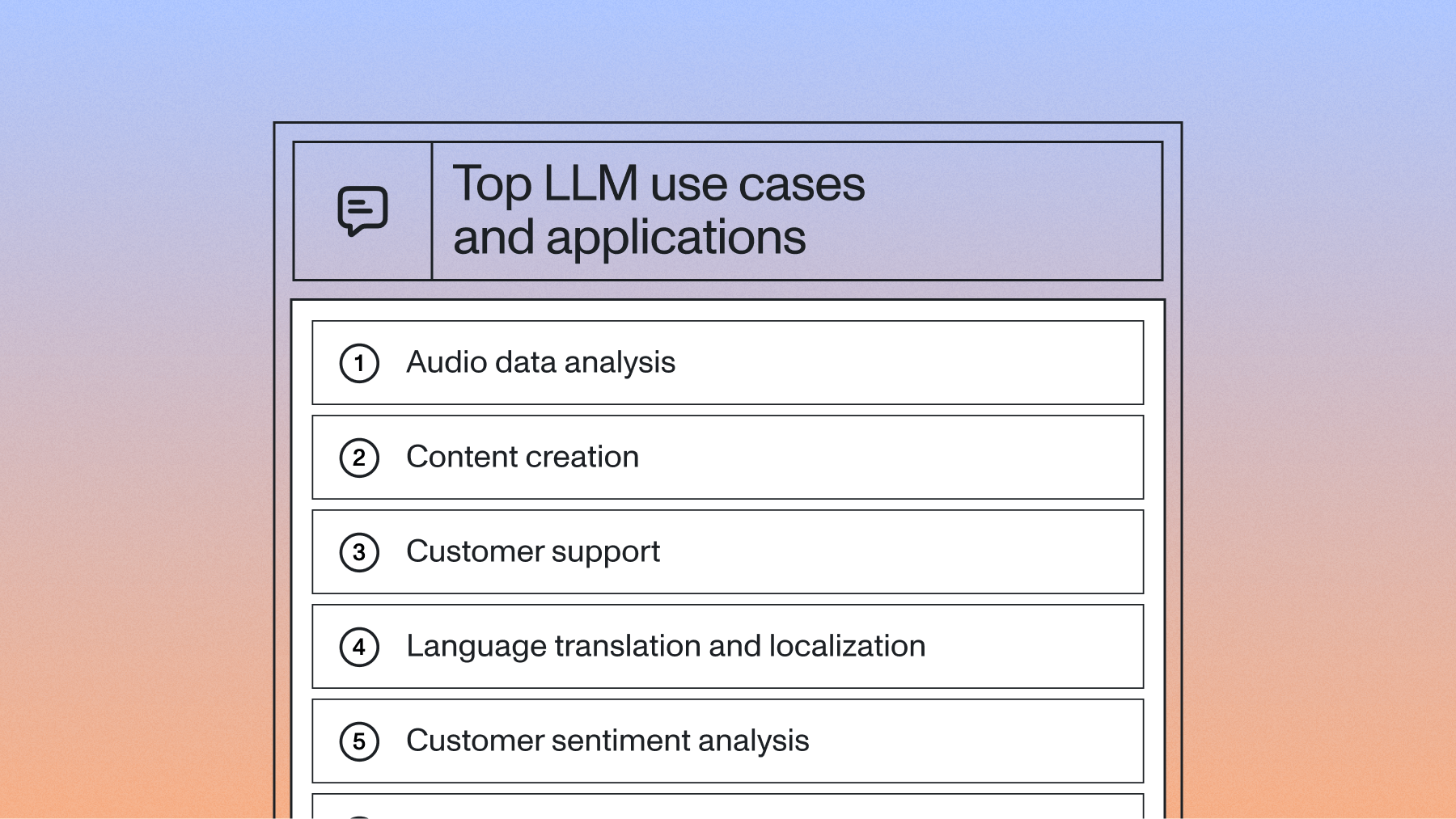
The most common LLM use cases are content generation, customer support automation, spoken data analysis, code assistance, and sentiment analysis. Voice agents and agentic AI workflows are the fastest-growing categories in 2026.
How are LLMs different from traditional AI?
Traditional AI models are trained for specific, narrow tasks. LLMs are general-purpose language models that handle a wide range of tasks—summarization, translation, analysis, code generation—without needing separate models for each one.
Can LLMs work with voice and audio data?
Yes. LLMs process voice data when paired with speech-to-text transcription. The transcript becomes the input for LLM analysis—enabling use cases like call summarization, voice agents, and spoken data analytics.
What industries benefit most from LLM applications?
Healthcare, financial services, legal, retail, media, education, and cybersecurity see the strongest LLM adoption. Any industry with large volumes of unstructured text or spoken data benefits from LLM processing.
How do you build an LLM-powered application?
Start with your data source—text or audio. For voice data, use a speech-to-text API to generate accurate transcripts, then connect those transcripts to an LLM for analysis. AssemblyAI's LLM gateway and Voice Agent API provide both layers through a single platform.