What metrics can I get from transcribed call center data?
Call center analytics tracks sentiment, agent performance, and customer experience from transcribed calls with metrics that guide better decisions.


Most contact centers still review one or two percent of their calls. A supervisor listens, fills in a scorecard, and that sample stands in for everything the other 98% of customers experienced.
Speech analytics exists to close that gap. But it only closes it if the transcript underneath is right, and that's the part that quietly decides whether the whole program works.
What is call center speech analytics?
Call center speech analytics is the practice of converting recorded and live voice calls into text, then analyzing that text for sentiment, topics, compliance risk, and agent behavior across every interaction rather than a sample. It replaces manual call review with automated analysis that covers 100% of conversations.
The pipeline is short: audio in, transcript out, structured signals extracted from the transcript, results pushed into a dashboard or a QA workflow. Everything a contact center analytics platform reports — sentiment trends, compliance flags, talk-time ratios, script adherence — is derived from that transcript. Nothing in the stack is more accurate than the layer it reads from.
Speech analytics vs. voice analytics: is there a difference?
In everyday contact center usage, the terms overlap almost completely, and vendors use them interchangeably. Where a distinction is drawn, speech analytics refers to what was said — the words, the topics, the entities, the compliance phrases — while voice analytics leans toward how it was said, meaning tonality, pacing, interruptions, and silence.
Both run on the same foundation. You need an accurate, speaker-attributed, timestamped transcript before either analysis is worth reading. So don't spend procurement cycles on the label. Spend them on the accuracy of the transcription layer and on whether speaker attribution holds up on real, messy calls.
What metrics can you get from transcribed contact center data?
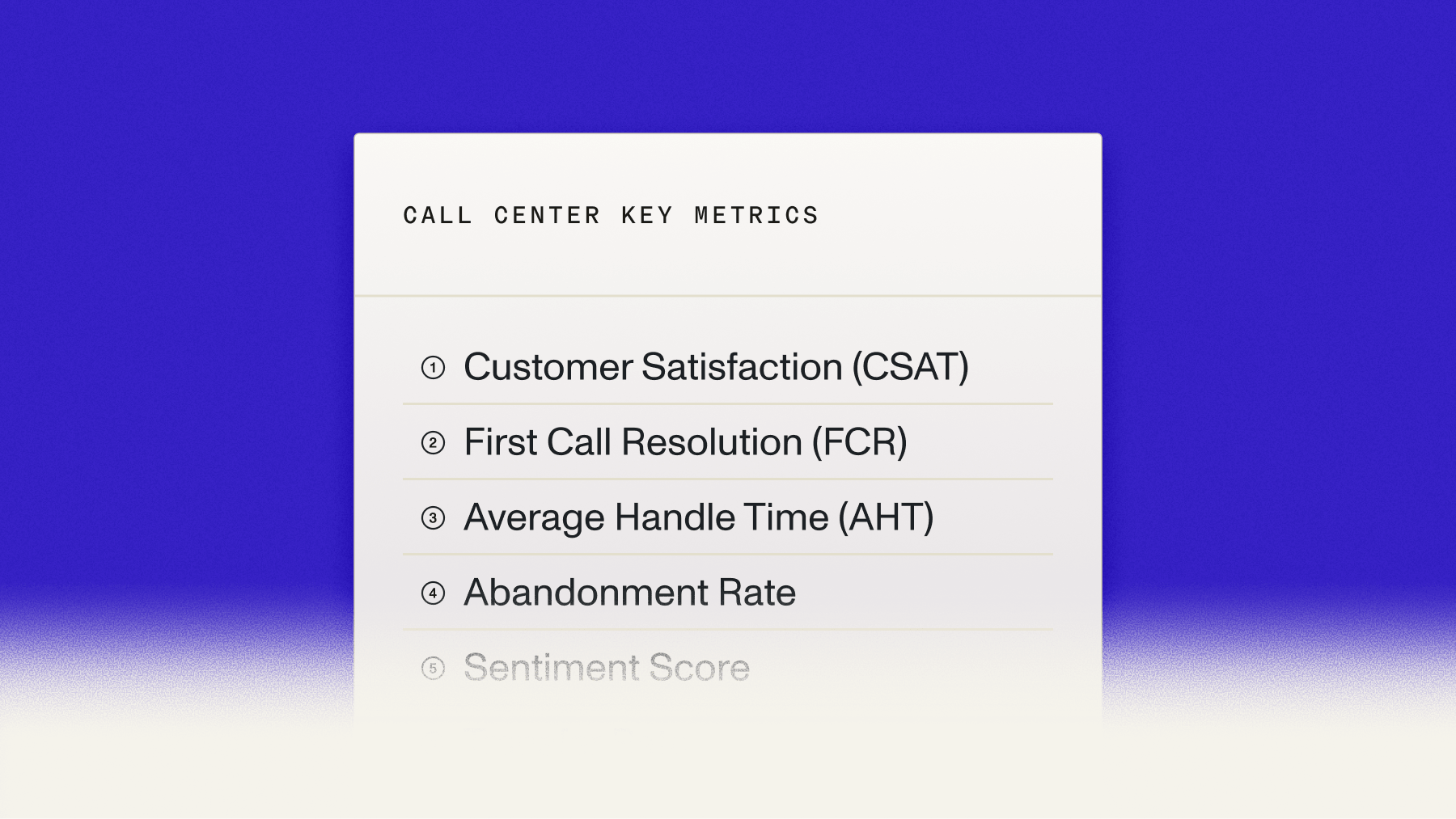
Transcription unlocks two families of metrics: operational metrics you already track but can now measure on every call instead of a sample, and conversational metrics that simply don't exist without text.
Why transcription accuracy sets the ceiling on everything downstream
Every analytics number you report is a derivative of the transcript. Get the transcript wrong and you don't get slightly worse analytics — you get confidently wrong analytics, which is considerably more expensive.
EdgeTier, which builds AI for customer service teams, put the failure mode plainly:
"The transcript quality is critical, both for user perception and our AI models. Once you lose trust in transcript accuracy, you erode trust in the product. For text classification, phrase detection, and agent evaluation, the language has to be correct — otherwise, the whole system falls apart." — Dr. Shane Lynn, CEO
Here's the accuracy picture on the Pipecat open speech-to-text benchmark, run on real agent conversations. Lower is better throughout:
Pay more attention to the entity rows than to the word error rate row. Word error rate treats every token equally, which means a botched "um" and a botched account number count the same. Contact centers do not work that way. The words that decide whether a call succeeds are names, addresses, order numbers, and phone numbers — and that's precisely where the spread between providers is widest: 15.31% entity error rate against Deepgram Flux's 50.50%, and 3.55% on phone numbers against 10.41%.
Full methodology and dataset details are on our benchmarks page. We've also written about the real cost of inaccurate transcription, which is mostly paid in rework rather than in API bills.
How does real-time voice analytics work in a contact center?
Real-time voice analytics streams live call audio over a WebSocket connection and returns transcripts, speaker labels, and sentiment while the call is still happening, which is what makes live supervisor alerts and in-call agent guidance possible. Post-call analytics tells you what went wrong. Real-time analytics gives you the chance to fix it before the customer hangs up.
Universal-3.5 Pro Realtime is built for exactly this environment, and three of its capabilities matter more on a contact center floor than anywhere else:
- Far-field voice focus. Contact center floors are loud. Neighboring agents, HVAC, headset bleed. Setting voice_focus to far-field isolates the primary speaker and suppresses the room; near-field is the setting for headsets and phone audio. It's a $0.10 per hour add-on on streaming transcription.
- Diarization with revision. Speakers get labeled live, then re-clustered with a single correction sent within about half a second of the stream ending — up to 10 speakers, which covers supervisor barge-ins, warm transfers, and three-way compliance calls. Talk-to-listen ratios and agent scorecards are only as good as this layer, and the mechanics are covered in our speaker diarization overview. It's a $0.12 per hour add-on.
- End-of-turn detection on content, not silence. The model weighs whether what has been said so far reads as a completed thought rather than endpointing on silence alone. That distinction matters when a customer pauses mid-sentence to read a number off a card — silence-based endpointing cuts them off, and everything downstream inherits a fragmented turn.
Streaming bills on session duration rather than audio duration, at $0.45 per hour base. For more on what live analysis makes possible operationally, see our piece on real-time conversation intelligence.
Agent assist and live coaching
Agent assist is where real-time transcription stops being a reporting feature and starts changing outcomes: surfacing the right knowledge base article mid-call, prompting a missed disclosure, or flagging a supervisor when sentiment drops.
The hard part isn't the suggestion engine. It's transcribing the short, mumbled, half-swallowed replies that customers give to direct questions — a spelled-out email address, a one-word confirmation, a street name. That's what agent_context addresses: pass the question that was just asked, and the model resolves the answer against it. The published contextual-prompting benchmark, run on 20,000 real voice-agent calls, shows what that kind of context is worth: a one-sentence scenario prompt cuts word error rate about 10% and place-name entity errors 21%, and hallucinated words fall rather than rise as context is added. Full figures are in the streaming prompting documentation. On Universal-3.5 Pro Realtime agent_context is included at no extra cost, as is rolling conversation memory.
How to implement contact center speech analytics
Start with three to five metrics tied to a decision someone will actually make. A program that tracks thirty metrics and changes nothing is a reporting exercise, not an analytics program.
Then decide the batch-versus-streaming split. Post-call QA, sentiment trending, and compliance sampling run fine as batch jobs on pre-recorded transcription at $0.21 per hour. Only live coaching, supervisor alerting, and agent assist need streaming. Most teams over-buy streaming early and then discover 90% of their volume could have been batch overnight. Current rates for every model and add-on are on the pricing page.
Baseline for at least 30 days before you change anything, so improvements are measurable against something real.
Prompt the model with context, not a keyword list
Contact center audio is full of vocabulary a general model has no reason to know: product SKUs, plan names, internal system names, competitor brands, and the specific way your agents phrase a disclosure.
The instinct is to dump all of it into a flat keyword list. Detailed, conversational prompts outperform that consistently. Instead of a comma-separated pile of terms, describe the call type in plain language — who's speaking, what the conversation is about, what kinds of products and account identifiers come up, and how they're typically pronounced. Give the model the situation, not a glossary. Keyterm prompting still has its place for a short list of must-get terms, and it's included on Universal-3.5 Pro Realtime, but the conversational prompt is what moves accuracy on domain-heavy calls.
One migration note: word_boost is deprecating on September 11, 2026. If your integration still calls it, move to keyterms prompting now rather than at the deadline.
Who's running this in production
Calabrio, the workforce optimization platform used across enterprise contact centers, has been direct about what it needs from the transcription layer:
"The transcription accuracy, reliability, and speed of AssemblyAI's API have greatly enhanced our operations, reinforcing our trust in their technology and solidifying our partnership." — Raj Shankar, SVP Product, Calabrio
The full story is on our Calabrio customer story. CallRail, which does call tracking and marketing attribution, frames the outcome on the business side:
"The capabilities AssemblyAI enables us to build help businesses market confidently while saving time and money. It's powerful, almost magical to see it work." — Ryan Johnson, Chief Product Officer, CallRail
The metric nobody puts on the dashboard
Here's what a year of these deployments tends to reveal: the highest-value output of a speech analytics program usually isn't a metric at all. It's the list of things customers ask for that your product doesn't do.
That signal exists in every contact center already. It's sitting in the 98% of calls nobody listens to, and it's the reason to transcribe everything rather than sample. The QA scorecards justify the budget. The product roadmap input is what makes it worth the trouble. If you want more patterns from teams already doing this, we've catalogued AI use cases in contact centers.
Frequently asked questions
What's the best speech-to-text API for contact center analytics?
The right choice for contact center analytics is whichever model is most accurate on entities — names, addresses, account numbers, phone numbers — rather than the one with the lowest headline word error rate. On the Pipecat open benchmark, Universal-3.5 Pro Realtime posts a 15.31% entity error rate and 3.55% on phone numbers, against 50.50% and 10.41% for Deepgram Flux. Test any candidate on your own recordings before committing, since contact center audio varies enormously by industry and telephony setup.
What insights can AssemblyAI extract from contact center conversations?
Beyond the transcript itself, AssemblyAI extracts sentiment at sentence level, 50+ entity types, IAB topic categories, content safety labels, and speaker-attributed turns for talk-time and interruption analysis. PII redaction works on both transcripts and audio, so recordings can be stored without account numbers or card details in them. These run in a single Speech Understanding request rather than as separate vendor calls.
Can AssemblyAI integrate with existing contact center platforms?
Yes. AssemblyAI is an API, so it connects to whatever CCaaS or recording platform you already run rather than replacing it. Pre-recorded transcription takes files or URLs from your recording storage, and streaming connects over a standard WebSocket that works with any telephony stack able to forward audio. There's no SDK requirement and no proprietary client.
How does AssemblyAI compare to AWS Transcribe for contact center analytics?
The practical differences show up in entity accuracy, speaker diarization quality, and pricing structure rather than in feature checklists. AssemblyAI publishes word error rate, entity error rate, and diarization results on a public benchmarks page and bills per second with no minimum commitment. Run both against a sample of your own calls and compare entity accuracy specifically, since that's what contact center analytics depends on.
Can speech-to-text APIs detect profanity or compliance issues?
Yes. Profanity filtering and content safety detection are standard features, and compliance monitoring works by combining transcription with topic and phrase detection across every call rather than a sample. Required disclosures, prohibited claims, and escalation language can all be flagged automatically. Because the analysis covers 100% of interactions, compliance moves from spot-checking to full coverage.
How long does it take to implement call center speech analytics from scratch?
A working proof of concept — recordings in, transcripts with sentiment and entities out — is typically a few days of engineering work, since it's an API call rather than a platform deployment. The longer part is organizational: agreeing on which three to five metrics matter, baselining for 30 days, and wiring results into the QA workflow people already use. Teams that treat it as a data engineering project ship faster than teams that treat it as a software procurement.
Lorem ipsum dolor sit amet, consectetur adipiscing elit, sed do eiusmod tempor incididunt ut labore et dolore magna aliqua. Ut enim ad minim veniam, quis nostrud exercitation ullamco laboris nisi ut aliquip ex ea commodo consequat. Duis aute irure dolor in reprehenderit in voluptate velit esse cillum dolore eu fugiat nulla pariatur.
Related posts