The best 7 ambient AI scribes
This guide compares the top 7 ambient AI scribe solutions for healthcare providers, covering key features, pricing, EHR integrations, and implementation considerations to help you choose the right documentation system for your practice.

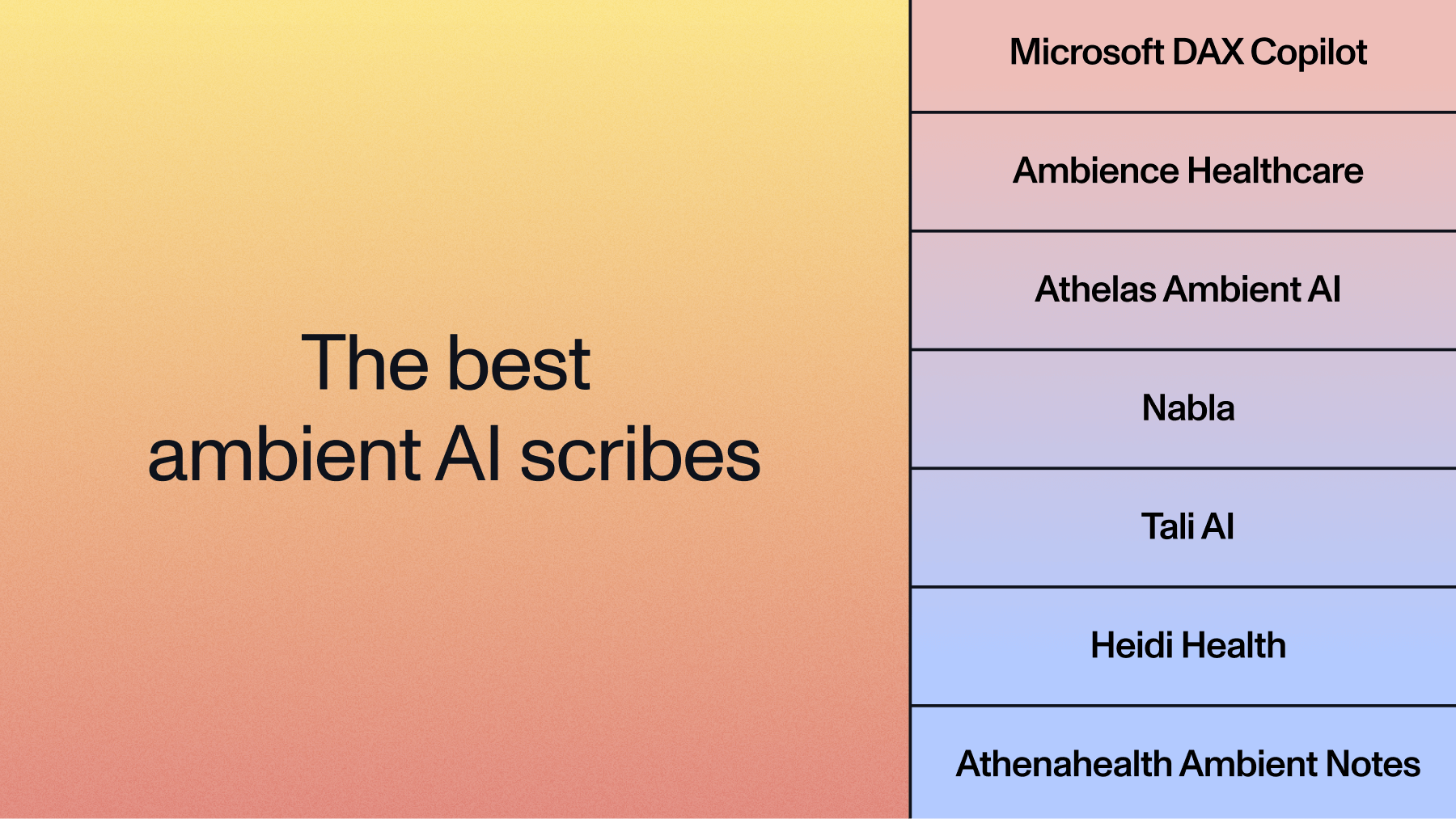

An internist finishes her last patient at 5:15 and opens her laptop at 8:40 that night to write eleven notes from memory. That gap — the one between the encounter and the documentation — is what every product on this list is trying to close. Ambient AI scribes listen to the visit, and the note is waiting when the clinician walks out of the room.
The category has matured fast, and the products have diverged more than the marketing suggests. Some are EHR-native and only work if you're on that EHR. Some are standalone apps a solo practitioner can start using this afternoon. Some are enterprise deployment programs with a scribe attached.
This is a working comparison of seven, plus the part most roundups skip: when buying an ambient scribe is the right call, and when you should build one. We make the speech-to-text layer a number of these companies run on, so I'll be explicit about where that biases me — including the cases that don't call for building anything.
The seven at a glance
Every vendor here publishes current pricing on their own site, and it moves. Check it there rather than trusting a number in a blog post — including this one.
What an ambient AI scribe actually is
An ambient AI scribe listens to a clinical encounter and produces documentation from it, without the clinician dictating or typing. "Ambient" is the load-bearing word: the microphone is in the room rather than at the clinician's mouth, and nobody speaks to the machine.
Under the hood, four stages:
1. Capture
A phone, tablet, or room device. Far-field audio, ambient noise, whoever's in the room.
2. Transcribe and diarize
Speech-to-text with speaker attribution. Everything downstream depends on this stage, and it's the one product comparisons never look at.
3. Structure
An LLM turns conversation into a SOAP note, an HPI, an assessment and plan.
4. Deliver
Into the EHR as a draft the clinician reviews and signs.
Stage 2 failures are invisible until they're not. If the transcript logs the patient's reported symptom as the clinician's observation, or turns "hydralazine" into "hydroxyzine," the LLM downstream will confidently structure wrong information into a clean-looking note. Medical entity accuracy and speaker attribution are evaluation criteria, not assumed table stakes.
1. Microsoft DAX Copilot
The incumbent, built on Nuance's clinical documentation lineage and now folded into Microsoft's healthcare portfolio. Deepest Epic integration in the category, extensive specialty coverage, and the security and procurement posture large systems expect.
Pick it if you're a large health system already committed to Microsoft and Epic, and you value integration depth and vendor stability over speed of rollout.
Think twice if you're small, fast-moving, or want to be live this quarter. This is an enterprise deployment, with the timeline that implies.
2. Ambience Healthcare
Positions itself as more than a scribe — documentation plus coding support plus referral and order capture, aimed at multi-specialty systems where the coding accuracy has direct revenue consequences.
Pick it if your business case rests as much on coding capture as on clinician time saved, and you run enough specialties that per-specialty depth matters.
Think twice if you want a simple note-writing tool. You'll pay for surface area you don't use.
3. Commure (Athelas) Ambient AI
Ambient documentation inside a broader healthcare operations platform covering revenue cycle, staffing, and patient engagement. If you're consolidating vendors, that's the appeal; if you only want a scribe, it's a lot of product.
Pick it if you're looking to reduce vendor count and the other modules solve problems you have anyway.
Think twice if you want a point solution you can rip out cleanly in a year.
4. Nabla
Strong reputation for fast clinician adoption and low-friction workflow, with genuine multilingual support — which matters more than most buyers realize until they see their own patient mix.
Pick it if adoption risk is your main worry. Clinician enthusiasm is the difference between a pilot that expands and a pilot that dies.
Think twice if you need deep specialty templates or heavy enterprise governance features.
5. Tali AI
Built with Canadian practices and Canadian EMRs in mind, combining ambient scribing with dictation and clinical reference lookup in one assistant.
Pick it if you're in Canada. The EMR fit and data residency posture are a real advantage there.
Think twice if you're US-based with Epic or Cerner — you're not the primary design target.
6. Heidi Health
The most accessible option for individual clinicians and small practices. Browser-based, quick to start, generous template customization, and a free tier that lets a skeptical clinician test it on their own before anyone signs anything.
Pick it if you're a solo practitioner or small group, or you want a low-stakes way to find out whether ambient scribing changes your evenings.
Think twice if you need SSO, audit tooling, and centralized administration across hundreds of clinicians.
7. Athenahealth Ambient Notes
Ambient documentation native to athenahealth. The integration story writes itself because there's only one integration.
Pick it if you're on athenahealth. The friction of adopting a first-party feature is close to zero.
Think twice if you're not, or if you expect to switch EHRs. This choice is coupled to that one.
Abridge and Suki come up constantly in this evaluation too. Buyers searching "an ambient scribe like DAX or Abridge" are usually really asking whether any of these can be bent to a workflow none of them were built for. Which brings us to the other option.
Buy or build: the honest version
I sell the ingredient, not the finished product, so take this with the appropriate grain of salt — but I'd rather be useful than convert you.
Buy if you're a provider organization
If you run a clinic or health system and the goal is that your clinicians get their evenings back, buy. All seven products above have solved problems you'd otherwise rediscover: consent flows, EHR write-back, specialty templates, onboarding, support. Building your own scribe for your own clinicians is rarely the right use of a provider organization's engineering capacity.
Build if you're a software company
If documentation is part of a product you sell — a specialty EHR, a telehealth platform, a behavioral health app, a veterinary system — buying a general scribe means bolting a competitor's UI onto your product and paying per clinician for a workflow you don't control.
Three situations where building clearly wins:
- Your workflow isn't a SOAP note. Physical therapy progress notes, ABA session data, dental charting, veterinary records. Generic templates fight you.
- Documentation is a feature of your platform. You want it in your UI, in your data model, priced into your plans.
- Your economics don't survive per-seat pricing. At $0.36/hr for transcription with Medical Mode, an hour of clinical audio costs less than a coffee. Per-clinician monthly subscriptions across thousands of clinicians rarely pencil out the same way.
What the speech layer needs to do
If you build, the transcription layer is the part you can't paper over. Here's what we've learned matters, running the model underneath a number of these products.
Medical entity accuracy, measured properly
Word error rate is the wrong metric. A transcript can post an excellent WER while dropping every drug name, because drug names are a small fraction of total words. Missed Entity Rate counts how often the drugs, conditions, and procedures spoken in the audio fail to appear in the transcript.
Universal-3.5 Pro with Medical Mode enabled — one parameter, domain: "medical-v1" — posts a 3.2% Missed Entity Rate, the lowest across the providers we've benchmarked. Against our own base model with Medical Mode off, it delivers roughly 20% fewer missed medical entities and 87% fewer entity errors. Methodology on the benchmarks page.
Diarization that survives a real encounter
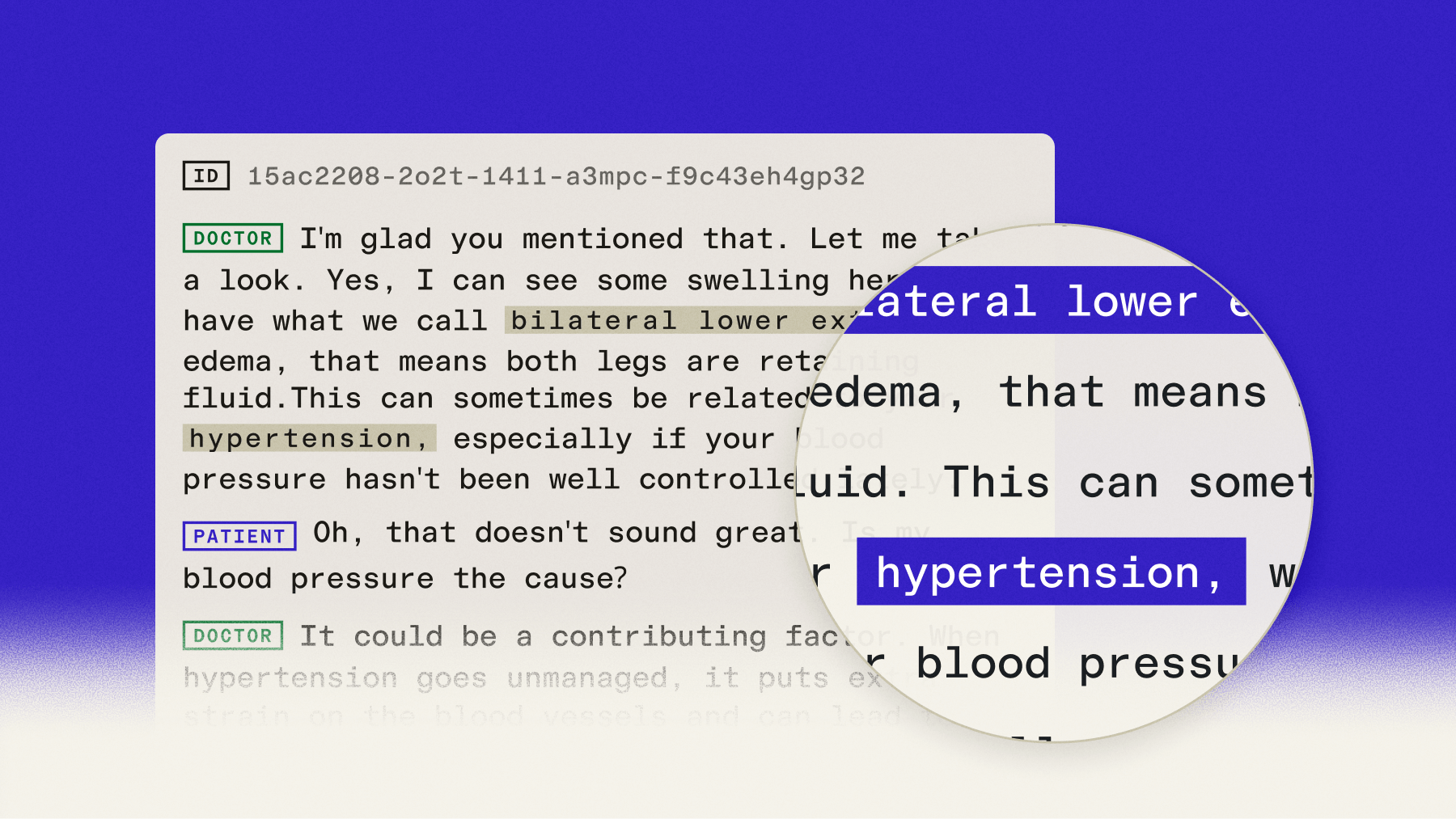
Clinical conversation is nothing like a podcast. The clinician speaks in paragraphs; the patient answers in three words, often on top of the question. Diarization tuned for clean turn-taking drops exactly those short turns — and the patient's three words are frequently the clinically important part.
Universal-3.5 Pro's diarization is the most accurate we've shipped, and it's optimized for cpWER rather than DER. That distinction matters: DER scores how much audio time landed on the right speaker and barely penalizes losing a two-word answer, while cpWER scores the words in each speaker's transcript — what your note generator actually consumes. Streaming diarization supports revision, correcting early attributions as audio arrives, up to 10 speakers.
Far-field configuration
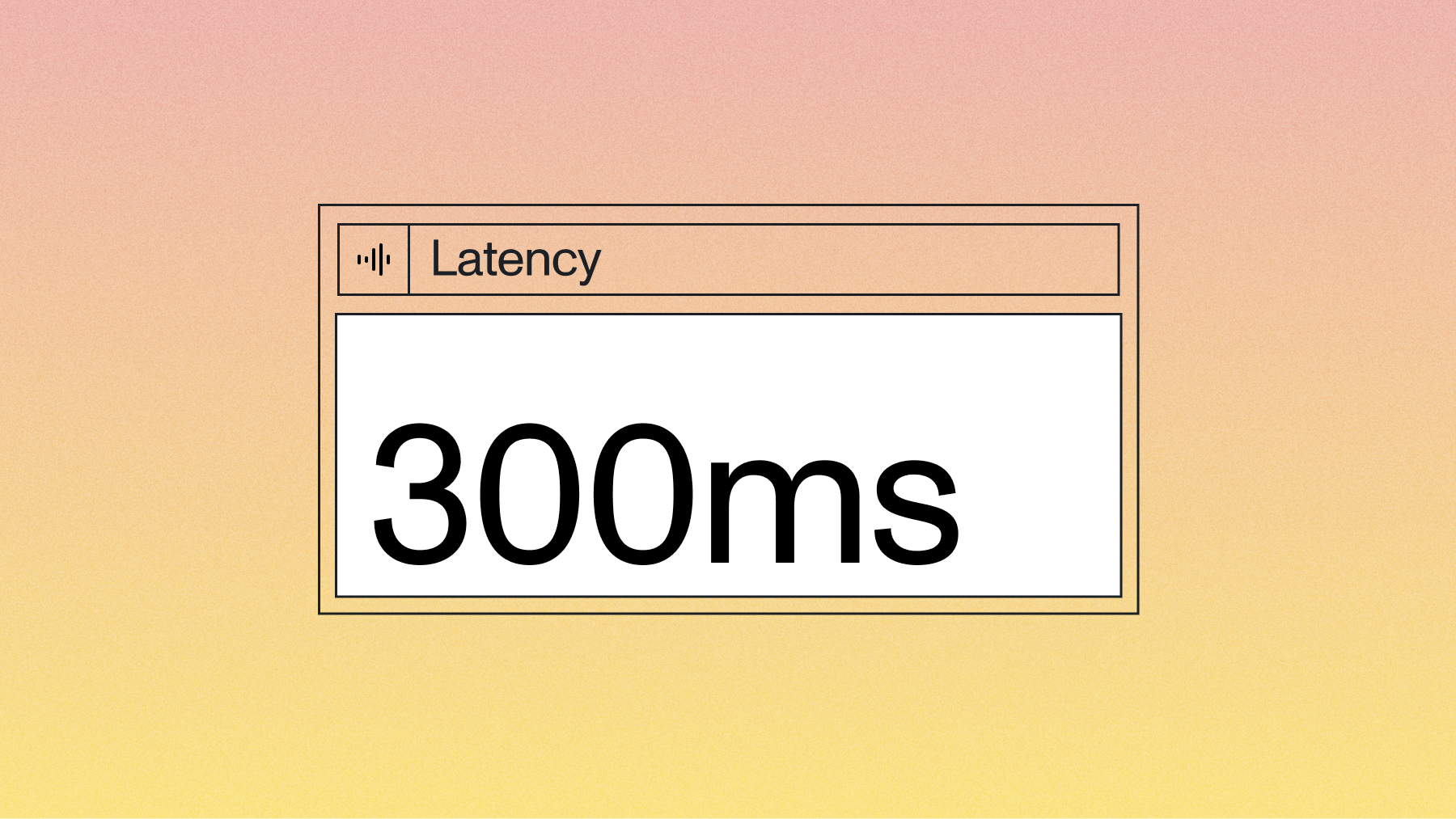
Ambient means the microphone is across the room. Set voice_focus to far-field and you get accuracy back for free. For documentation, run mode: "max_accuracy" — nobody's waiting on a 200ms round trip to read a note about a visit that just ended.
Multilingual encounters
Two distinct facts here, and they get conflated constantly. The base model code-switches natively across 18 languages with no configuration, so an encounter that shifts between English and Spanish mid-sentence transcribes correctly. Medical Mode's clinical entity boost covers English, Spanish, German, and French. If your patient population sits inside those four, you get both.
Context, which is the cheapest win available
The finding that should change how you architect this: in an internal healthcare test, feeding the model a patient's prior-visit note as context cut missed medical terms by 31%. Not a fine-tune, not a new model — just passing the document that already lists this patient's medications and conditions. If your product has the last note, use it.
A minimal ambient scribe pipeline
Recorded encounter to diarized clinical transcript in about fifteen lines. Note that async uses speech_models, plural:
import assemblyai as aai

aai.settings.api_key = "YOUR_API_KEY"

config = aai.TranscriptionConfig(
    speech_models=["universal-3-5-pro"],
    domain="medical-v1",
    speaker_labels=True,
    speakers_expected=2,
    format_text=True,
)

transcript = aai.Transcriber(config=config).transcribe(
    "./encounter.wav"
)

if transcript.status == "error":
    raise RuntimeError(transcript.error)

for utterance in transcript.utterances:
    print(f"Speaker {utterance.speaker}: {utterance.text}")
For a live view during the encounter, Universal-3.5 Pro Realtime connects at wss://streaming.assemblyai.com/v3/ws — streaming uses the singular speech_model:
from assemblyai.streaming.v3 import (
    StreamingClient,
    StreamingClientOptions,
    StreamingParameters,
    TurnEvent,
)

def on_turn(client, event: TurnEvent):
    if event.end_of_turn:
        print(event.transcript)

client = StreamingClient(StreamingClientOptions(api_key="YOUR_API_KEY"))
client.on(TurnEvent, on_turn)

client.connect(
    StreamingParameters(
        speech_model="universal-3-5-pro",
        domain="medical-v1",
        sample_rate=16000,
        speaker_labels=True,
        voice_focus="far-field",
        mode="max_accuracy",
    )
)
From there the diarized transcript goes to an LLM with an explicit output schema. One rule worth enforcing in code: make the model ground every clinical claim in a transcript span, and flag anything it can't. A note that invents a plausible dose is worse than one with a gap.
Teams doing this in production include Sully AI, Heidi Health, Deepscribe, Knowtex, and Magentus Healthcare. On the platform side, Gautam Pradeep, Tech Lead at Commure, put it this way:
"We've integrated the newest models from AssemblyAI for pre-recorded audio ASR in our ambient product, and it's been excellent. We're now exploring Universal-3.5 Pro for async and realtime speech-to-text capabilities for new use cases. What's been just as important is the reliability of the platform itself—both technically and in terms of partnership."
What it costs to build versus buy
Intake, triage, follow-up calls in one WebSocket
Current rates are on the pricing page. The honest caveat: transcription is the cheap part. Your real build cost is EHR integration, onboarding, and the review UI.
PHI, BAAs, and what procurement will ask
AssemblyAI signs a Business Associate Addendum (BAA) for customers processing PHI, which makes us a business associate under HIPAA. Terms and process are at can you sign a BAA and legal/business-associate-agreement. Alongside that: PHI redaction across both audio and transcripts, SOC 2 Type 2, and self-hosted or EU-residency deployment via api.eu.assemblyai.com where isolation is required.
Ask every shortlisted vendor the same four questions: will you sign a BAA, can you redact PHI from audio as well as text, what's your retention policy and can I shorten it, and where does the audio physically go. Vendors who answer crisply have thought about it. Vendors who answer with a badge have not.
How to actually run the evaluation
Pilot with your hardest audio, not your best
The noisiest room, the fastest talker, the bilingual encounter, the patient who mumbles. Products differentiate at the edges.
Score entities and speaker attribution separately
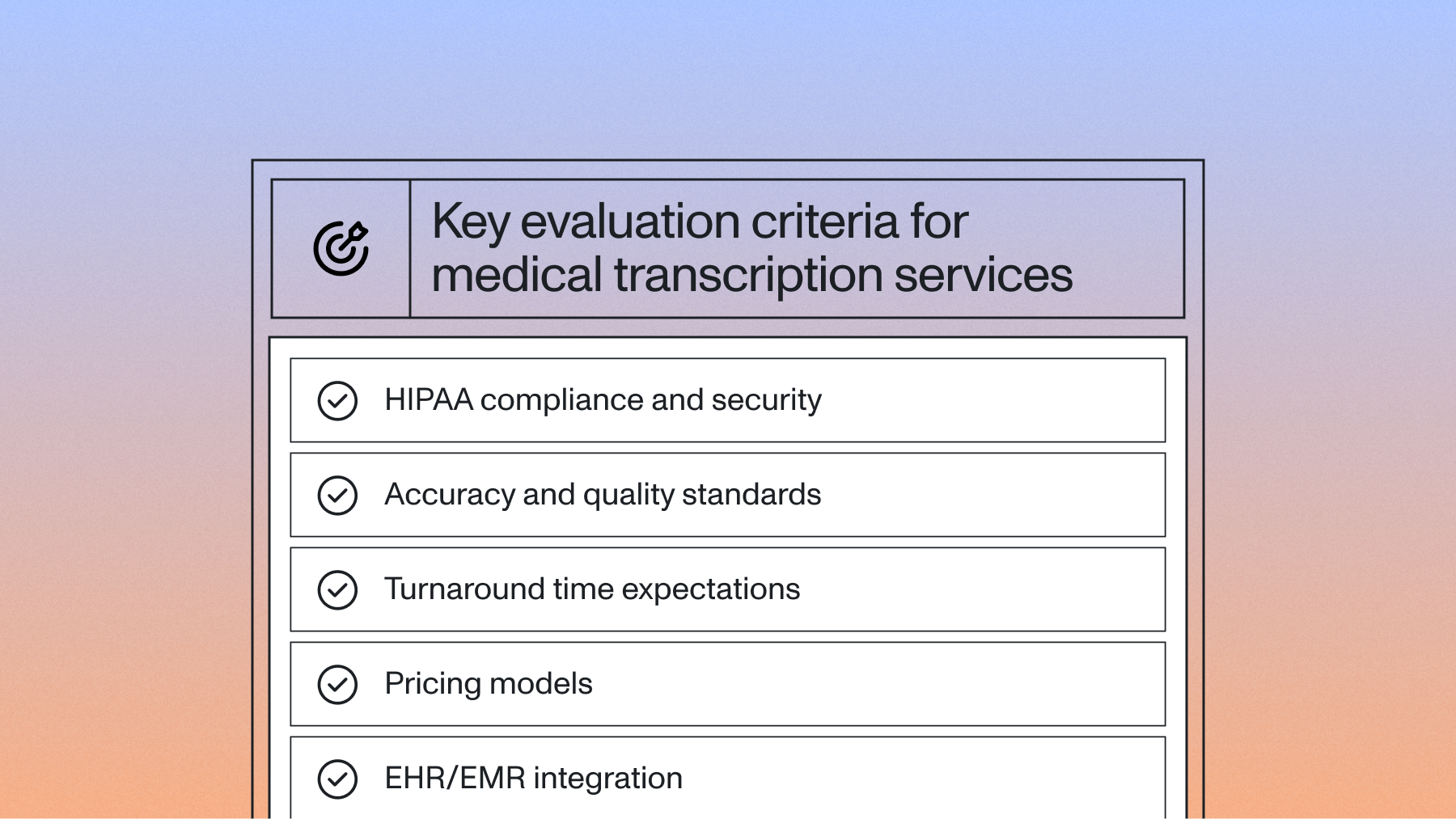
List the drugs, conditions, and procedures actually spoken in your pilot recordings and count how many landed correctly. Then check whether the patient's short answers were attributed to the patient. These two numbers predict note quality better than any demo.
Measure edit time, not satisfaction
How many seconds does a clinician spend fixing each note? That's the number that decides whether adoption survives month three.
Where this category goes next
The current generation of ambient scribes all share one limitation: each encounter starts cold. The model hears the visit and nothing else. That's why the 31% reduction in missed medical terms from a single prior-visit note is the most interesting number in this post — it says the accuracy ceiling isn't in the model anymore, it's in what you hand the model before the visit starts.
Follow that out a couple of years and the winning products won't be the ones with the best transcription. They'll be the ones with the tightest loop into the record — the system that already knows this patient's medications, their specialists, and this clinic's shorthand, and gets more accurate every visit. That's a data-integration advantage, not a model one, which is why EHR-native players are worth watching, and why software companies building documentation inside a product that already holds the record may have an edge nobody's priced in yet.
More on the build path: how to build an AI medical scribe, AI medical transcription, medical voice recognition, the healthcare solutions overview, and speech-to-text generally.
Frequently asked questions
What is the best API for building an ambient AI scribe?
For the transcription layer, the criteria that matter are medical entity accuracy, diarization quality, and far-field handling. Universal-3.5 Pro with Medical Mode posts a 3.2% Missed Entity Rate — lowest across the providers we've benchmarked — with cpWER-optimized diarization and a far-field voice focus setting. It's one parameter to enable and the same model ID for async and streaming. Test it on your own room recordings before you decide.
Can I build an AI medical scribe like DAX or Abridge?
The transcription and note-generation layers are genuinely accessible now — a working prototype is a day's work on top of a diarized clinical transcript. What takes real time is everything around it: EHR write-back, consent handling, specialty templates, and a review UI clinicians will tolerate. Build if documentation is part of a product you sell or your workflow isn't a standard SOAP note. If you're a provider organization documenting your own visits, buy.
What's the best speech-to-text for far-field ambient clinical environments?
Far-field is the harder case, and configuration matters as much as model choice. Set voice_focus to far-field for room microphones, run mode: "max_accuracy" since documentation isn't latency-sensitive, and turn on speaker labels with revision so early attributions get corrected. Build your evaluation set from actual room recordings — headset audio will flatter every vendor equally.
How does AssemblyAI handle HIPAA and PHI?
AssemblyAI signs a Business Associate Addendum (BAA) for customers processing PHI, which makes us a business associate under HIPAA. Alongside the BAA: PHI redaction across audio and transcripts, SOC 2 Type 2, and self-hosted or EU data residency options. Details at can you sign a BAA.
Do ambient AI scribes work for multilingual patient visits?
The underlying speech model matters more than the scribe's marketing here. Universal-3.5 Pro code-switches natively across 18 languages with no configuration, so an encounter that moves between English and Spanish mid-sentence transcribes correctly. Medical Mode's clinical entity accuracy covers English, Spanish, German, and French. Those are two separate capabilities — ask any vendor which one they actually mean.
What does it cost to build an ambient scribe instead of buying one?
The transcription layer runs $0.36/hr with Medical Mode for pre-recorded audio, or $0.60/hr for live streaming, with current rates on the pricing page. That's the cheap part. Budget the real money for EHR integration, clinician onboarding, and the note review interface. Building pays off when you're a software company that controls the workflow, not when you're a clinic that just needs notes written.
Lorem ipsum dolor sit amet, consectetur adipiscing elit, sed do eiusmod tempor incididunt ut labore et dolore magna aliqua. Ut enim ad minim veniam, quis nostrud exercitation ullamco laboris nisi ut aliquip ex ea commodo consequat. Duis aute irure dolor in reprehenderit in voluptate velit esse cillum dolore eu fugiat nulla pariatur.
Related posts