10 call center metrics you can extract from AI transcripts
Most call center metrics are still measured on a 2% sample. With accurate AI transcripts, the KPIs you used to sample become metrics you measure across every call.


Most call center metrics are still measured on a sample. A QA team listens to 2% of calls, scores them by hand, and extrapolates. That worked when listening was the only option. It doesn't work now, because the transcript of every call is available in seconds — and once you have accurate transcripts, the metrics you used to sample become metrics you measure across 100% of interactions.
This guide covers the ten call center metrics worth extracting from AI transcripts, how each one is derived, and the accuracy you need before you can trust the number. Because that's the catch: metrics extracted from a bad transcript are worse than no metrics, since they look authoritative while being wrong.
What are the most important call center metrics (KPIs)?
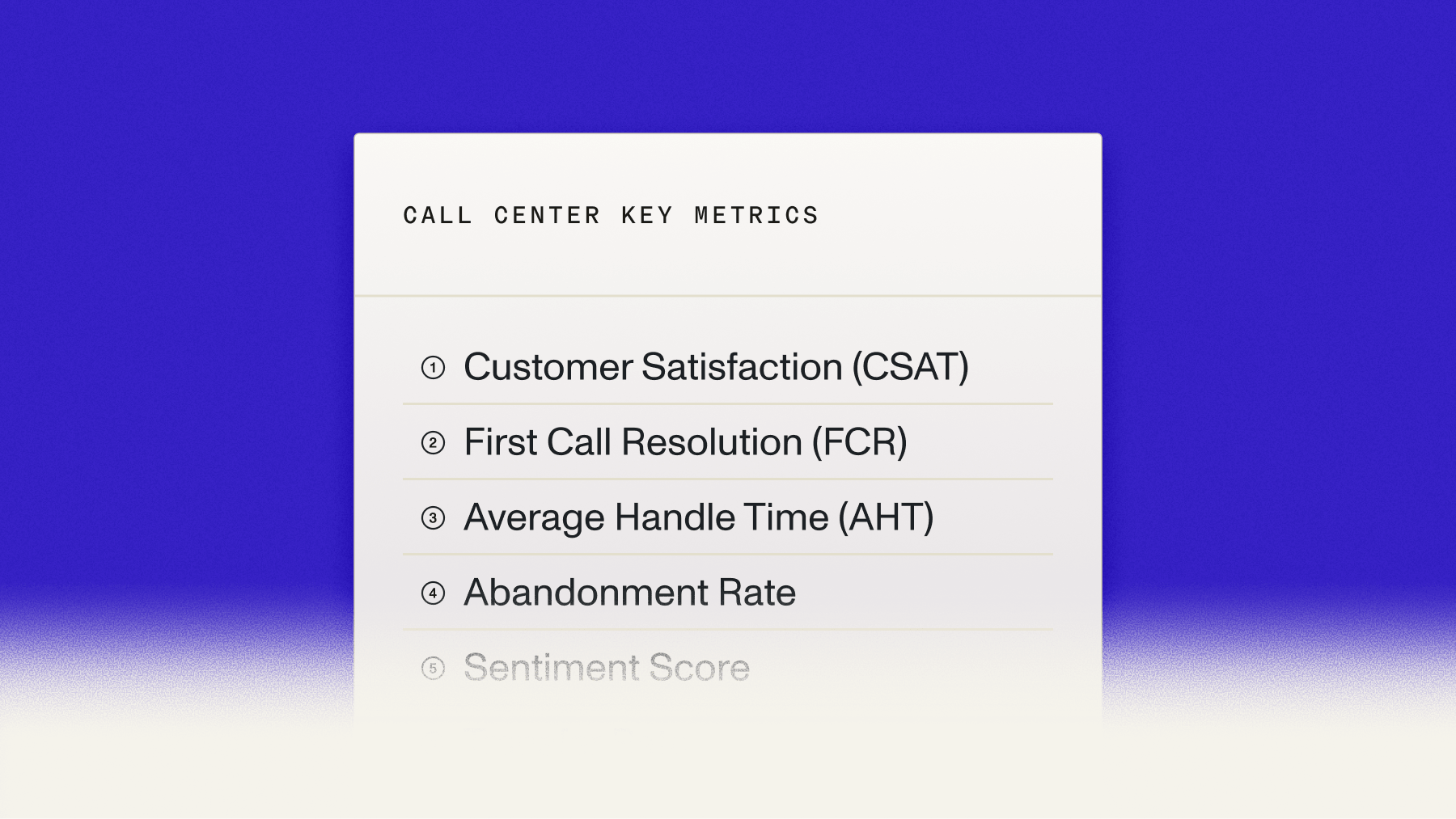
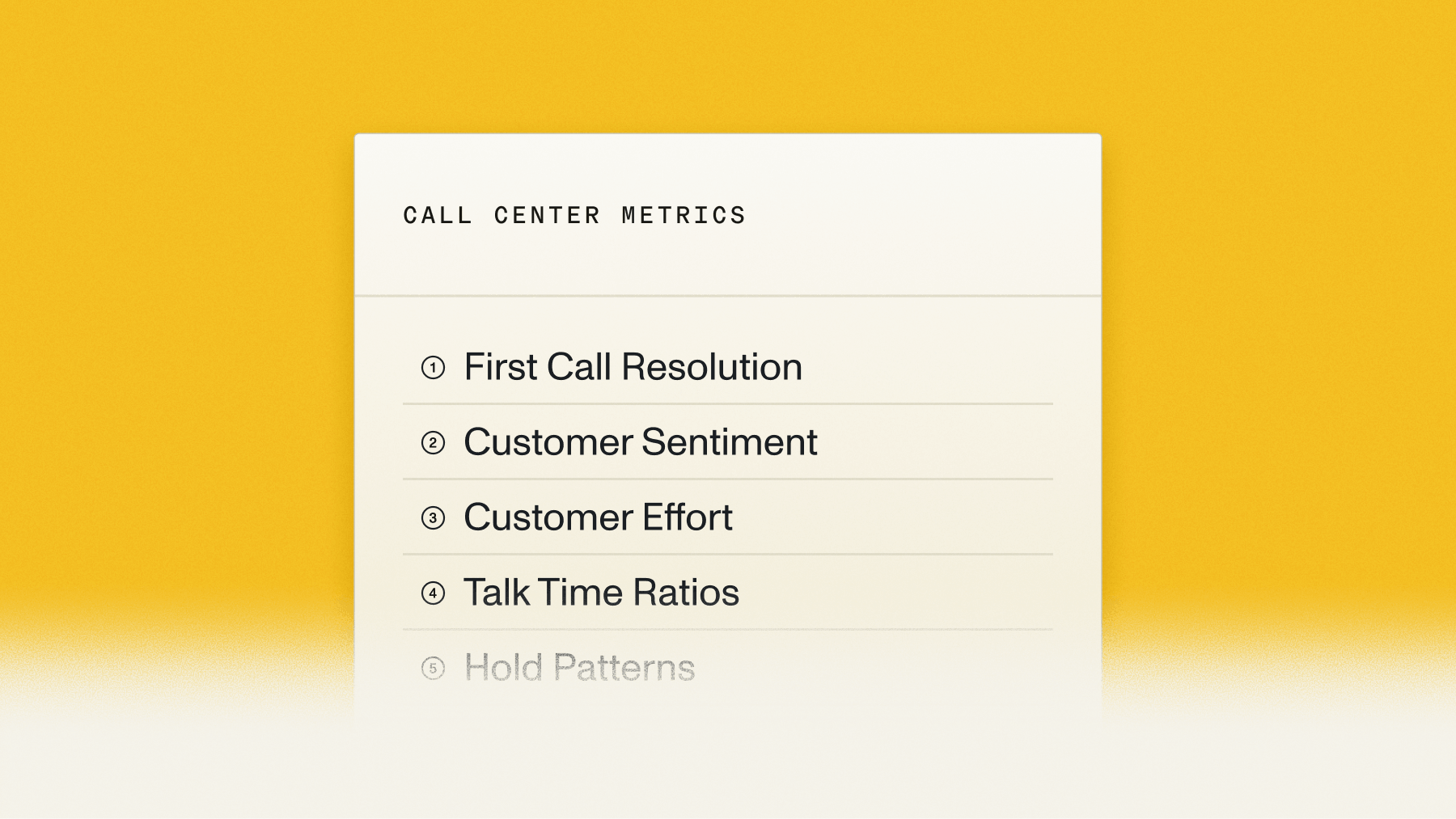
Call center KPIs fall into three buckets: efficiency (how fast you resolve), quality (how well you resolve), and compliance (whether you resolved within the rules). The ten below span all three, and every one of them can be computed from a transcript plus Speech Understanding — no manual scoring required.
The KPI reference table
Why transcript accuracy decides whether the metrics are usable
Here’s the part most “top 10 metrics” articles skip. Every metric in that table inherits the error rate of the transcript underneath it. If the model mishears the caller’s account number, your compliance check fails silently. If it can’t tell two speakers apart, your talk-to-listen ratio is noise.
Accuracy gains on noisy, real-world contact-center audio are large — often the difference between a metric you can act on and one you have to caveat. Passing conversation context to the model sharpens recognition on domain terms and hard-to-hear entities, which is exactly where naive transcription drops the numbers your KPIs depend on.
The model doing the work is Universal-3.5 Pro for pre-recorded call analysis ($0.21/hr) and Universal-3.5 Pro Realtime for live agent-assist. If you’re building a voice agent into the flow, the Voice Agent API bundles speech-to-text, an LLM, and text-to-speech behind one WebSocket at a flat $4.50/hr.
Diarization: the metric behind the metrics
Half the KPIs above depend on knowing who spoke. Talk-to-listen ratio, agent vs caller sentiment, transfer detection — all of it collapses without accurate speaker separation. Universal-3.5 Pro ships the most accurate diarization AssemblyAI has released, measured on concatenated minimum-permutation WER (cpWER):
Full methodology is on our benchmarks page. When you’re deciding which speech-to-text API has the best diarization for call centers, cpWER is the number to compare — it captures both transcription and speaker-attribution error in one figure.
Turning transcripts into metrics with Speech Understanding
Raw text is only the starting point. Speech Understanding is the layer that converts transcripts into the structured signals your KPIs need:
- Sentiment analysis — scores each speaker’s turns, so you can measure caller sentiment separately from agent sentiment and use it as a CSAT proxy on 100% of calls.
- Entity detection — pulls out names, account numbers, products, and dates, which feed transfer detection, churn-risk signals, and compliance checks.
- Topic detection — classifies what each call is actually about, powering FCR, knowledge-gap analysis, and routing.
- PII redaction — detects and redacts personal and payment data in the transcript, so your analytics pipeline never stores what it shouldn’t.
Together these turn a wall of text into the dashboard your ops team actually reads. For a deeper look at the pattern, see conversation intelligence and AI use cases in contact centers.
Compliance, profanity, and PHI
Compliance is where accurate transcripts pay for themselves. You can flag missing disclosures, detect profanity or escalation language, and catch script deviations automatically — across every call, not a sample. For regulated audio, redact PII in-transcript with redact_pii, and redact it from the audio itself with redact_pii_audio.
If your calls touch protected health information — telehealth triage, pharmacy support, benefits lines — note the framing: AssemblyAI enables covered entities and their business associates subject to HIPAA to use the AssemblyAI services to process PHI. AssemblyAI is considered a business associate under HIPAA, and we offer a standard Business Associate Addendum (BAA) that safeguards PHI. We're a business associate under HIPAA; we sign a BAA. We don't claim to be a covered entity, and neither should your vendor.
Doing this at scale
These metrics only matter if they run across your whole call volume, not a QA sample. Calabrio, the workforce-optimization and conversation-intelligence platform, builds on AssemblyAI — and SVP of Product Raj Shankar puts it plainly: "The transcription accuracy, reliability, and speed of AssemblyAI's API have greatly enhanced our operations, reinforcing our trust in their technology and solidifying our partnership." Marketing-analytics leader CallRail runs on AssemblyAI too, turning millions of minutes of call audio into the KPIs above without a human touching a scorecard. That's the shift: from sampling calls to measuring all of them.
Get started
Explore Voice AI solutions for contact centers to see these metrics in production, or get your free API key and run Universal-3.5 Pro on your own call recordings.
Frequently asked questions
What's the best speech-to-text API for contact center analytics?
Look for accurate diarization and a Speech Understanding layer. Universal-3.5 Pro leads diarization at 30.17 cpWER and holds up on noisy, real-world audio, so downstream metrics like FCR and AHT stay accurate. Benchmark on your own call recordings before committing.
Which speech-to-text API has the best diarization for call centers?
On cpWER, Universal-3.5 Pro averages 30.17 versus ElevenLabs Scribe v2 at 35.26, Gladia at 36.87, and Deepgram Nova-3 at 37.92. Since most call center metrics depend on speaker attribution, diarization accuracy is the number that matters most.
How accurate does transcription need to be for reliable metrics?
Accurate enough that the errors don't corrupt the metric — high enough that speaker turns and key terms survive noisy audio. Passing conversation context to the model sharpens accuracy on domain terms, which is roughly the threshold where compliance checks and sentiment scores become trustworthy rather than directional.
Can speech-to-text APIs detect profanity or compliance issues?
Yes. With accurate transcripts plus topic and entity detection, you can flag profanity, missing disclosures, and script deviations automatically across every call — not a sample.
What can AssemblyAI extract from contact center conversations?
Sentiment per speaker, named entities, topics, and PII, plus accurate speaker-separated transcripts. Those feed FCR, AHT, talk-to-listen ratio, transfer rate, compliance adherence, and churn-risk signals.
Is AssemblyAI used at enterprise scale?
Yes. Contact-center and CX platforms including Calabrio and CallRail build conversation analytics on AssemblyAI, processing conversations at high volume.
Lorem ipsum dolor sit amet, consectetur adipiscing elit, sed do eiusmod tempor incididunt ut labore et dolore magna aliqua. Ut enim ad minim veniam, quis nostrud exercitation ullamco laboris nisi ut aliquip ex ea commodo consequat. Duis aute irure dolor in reprehenderit in voluptate velit esse cillum dolore eu fugiat nulla pariatur.