What kinds of businesses use automatic transcription?
Corporate transcription services deliver accurate, secure transcripts for meetings, calls, and legal needs with enterprise-level compliance and fast turnaround.


Corporate transcription transforms business audio into accurate, secure text that meets enterprise requirements, with the business transcription market valued at $30.42 billion in 2024 and projected to grow at 5.2% annually through 2030. Unlike consumer transcription services, corporate solutions provide the security certifications, integration capabilities, and specialized accuracy your business needs for legal compliance, customer insights, and operational efficiency.
This guide explains what corporate transcription services offer, how different departments use them, and whether managed services or speech-to-text APIs work better for your company. You'll learn the key features that separate enterprise-grade transcription from basic audio-to-text conversion, plus practical implementation approaches that scale with your business needs.
What are corporate transcription services?
Corporate transcription services convert your business audio into accurate text with enterprise security and compliance features. This means you get professionally formatted transcripts that meet your company's legal and security requirements, not just basic audio-to-text conversion.
You're probably wondering what makes this different from regular transcription. Consumer transcription works fine for personal recordings, but it can't handle sensitive business content or integrate with your company systems.
Here's what separates corporate from regular transcription:
- Security: Your audio gets encrypted and stored according to SOC 2, HIPAA, or GDPR standards
- Accuracy: Business terms, company names, and technical language get transcribed correctly
- Integration: Connects directly to your existing software through APIs and single sign-on
- Volume: Handles hundreds of hours of audio without quality dropping
- Compliance: Meets legal requirements for record-keeping and audit trails
Think of it this way: when a law firm transcribes a deposition, one wrong word could change the entire meaning of testimony. When your sales team transcribes client calls, you need those product names and dollar amounts to be perfect.
What do businesses use corporate transcription for?
You'll find corporate transcription in almost every department of a company. Each team has different needs: legal wants word-for-word accuracy, while sales teams care more about extracting customer insights.
Executive and leadership communications
Your C-suite generates hours of critical conversations every week. Board meetings, earnings calls, and strategic planning sessions all need accurate records for compliance and decision tracking.
Public companies must keep precise transcripts of earnings calls because the SEC requires it. One misheard financial figure in a transcript could trigger regulatory problems or mislead investors.
Legal and compliance documentation
Law firms and corporate legal teams transcribe everything that might end up in court. This includes depositions, witness interviews, and contract negotiations where every pause and correction matters.
You need these transcripts to capture:
- Depositions with exact timestamps for video sync
- Contract negotiations showing what terms were discussed
- Regulatory proceedings for compliance audits
- Internal investigations with proper chain of custody
Customer-facing interactions
Your sales and support teams transcribe customer calls to improve service and gather product feedback. A software company might transcribe thousands of support calls monthly to spot common technical issues, with recent research showing 62% of professionals saving over four hours per week through AI-powered transcription tools.
Contact centers use real-time transcription so supervisors can see live conversations and coach agents instantly. Marketing teams mine these transcripts to understand how customers actually talk about your products.
Internal business operations
HR departments transcribe interviews and performance reviews to maintain employment records. Project teams transcribe meetings to track decisions and accountability.
- Training sessions become searchable knowledge bases
- Team meetings generate automatic action items
- Performance reviews create legal protection records
- Onboarding interviews document new employee feedback
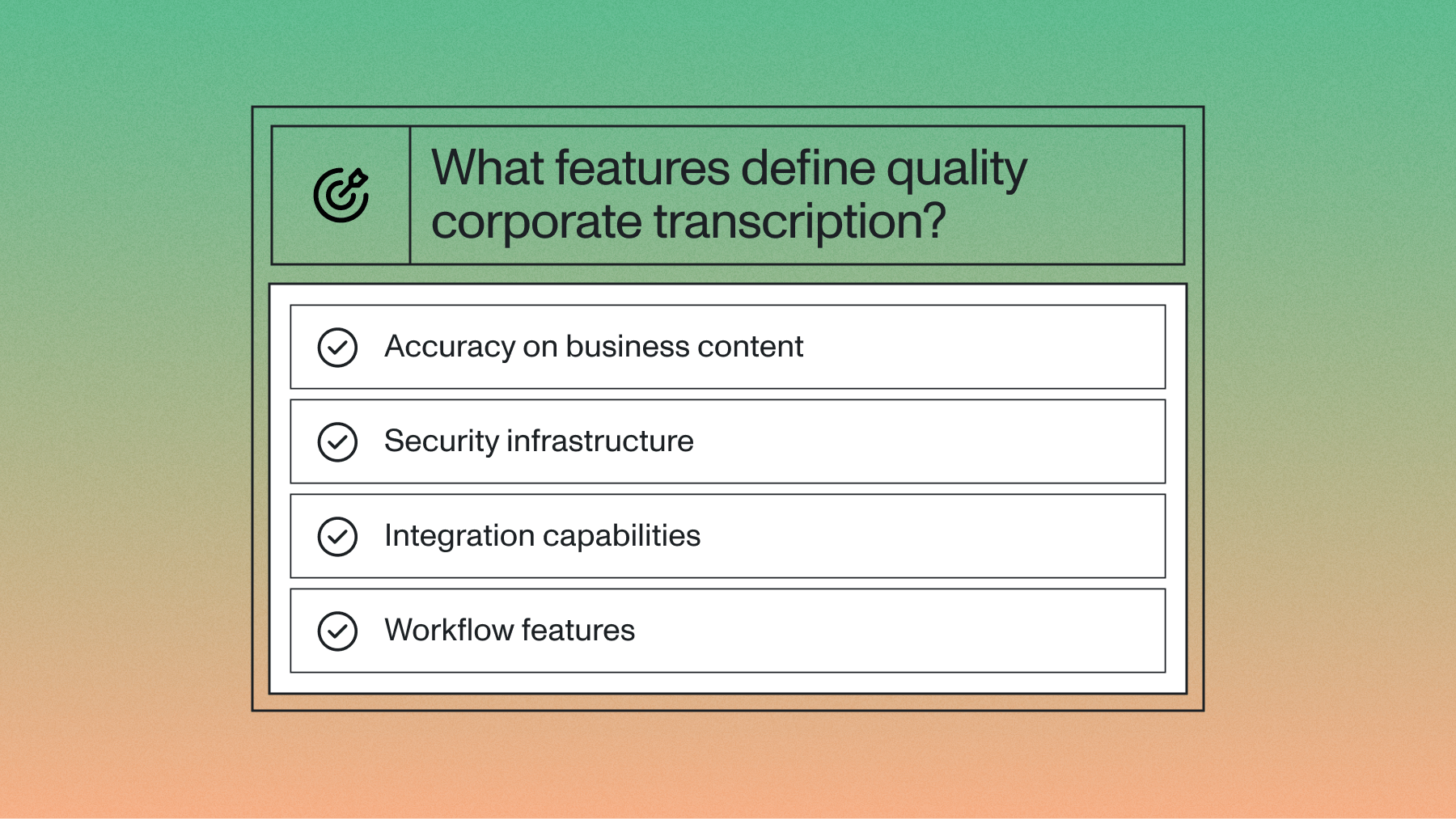
What features define quality corporate transcription?
Enterprise transcription needs capabilities that consumer services don't offer. The difference between good enough and business-critical accuracy can protect you from compliance issues or legal problems.
Accuracy on business content matters most. Your transcription service must correctly capture:
- Company and product names (distinguishing "Cisco" from "sysco")
- Financial figures with proper formatting
- Industry terminology and acronyms
- Email addresses and phone numbers exactly as spoken
Security infrastructure protects your sensitive data through:
- End-to-end encryption for all audio files and transcripts
- Role-based access so only authorized people see specific content
- Audit trails tracking every access and modification
- Data residency options keeping content in your preferred geographic region
Integration capabilities connect transcription to your workflows:
- REST APIs for custom application integration
- Webhooks that trigger actions when transcripts complete
- Single sign-on maintaining your company's authentication
- Batch processing for hundreds of files at once
Workflow features support team collaboration:
- Multi-user workspaces with permission management
- Custom formatting templates matching your company standards
- Advanced search across all your transcript libraries
- Export options for your business systems
Modern Voice AI models optimize specifically for corporate requirements. AssemblyAI's Universal models, for example, achieve significantly better accuracy on proper nouns and alphanumeric content—exactly what matters most in business transcription.
How to implement corporate transcription
You have two main options: managed transcription services or building with speech-to-text APIs. Your choice depends on your technical resources, volume, and integration needs.
Managed transcription services
Managed services handle everything for you. You upload files through a web portal, get completed transcripts back. This approach works best if you don't have technical teams or your transcription needs vary month to month.
Law firms often prefer managed services because they provide human review for legal terminology. These services can also certify transcript accuracy for court proceedings.
What you get:
- No technical setup required
- Human review for complex content
- Flexible pricing for variable volumes
- Certified transcripts for legal use
The tradeoffs:
- Higher per-minute costs
- Manual workflow limits automation
- Turnaround delays for non-rush orders
- Limited customization options
Building with speech-to-text APIs
API-based solutions integrate transcription directly into your business applications. Companies processing hundreds of hours monthly often save significantly on costs by switching from managed services to APIs.
A customer service platform might use streaming transcription APIs to display live call transcripts to agents. A video platform could automatically generate captions for uploaded content.
Key technical considerations you'll face:
- Real-time vs batch processing: Live meeting transcription requires streaming APIs with minimal delay, while recorded content can use batch processing for better accuracy
- Speaker separation: Multi-speaker meetings need speaker diarization to identify who said what
- Audio quality: Background noise, echo, and poor connections require robust speech recognition models
- Custom vocabulary: Adding company-specific terms improves accuracy on brand names and products
AssemblyAI's streaming speech-to-text API provides real-time transcription, with speaker separation available through multichannel audio where each speaker uses a separate channel and streaming session, making it practical for companies building live meeting transcription into their products.
Lorem ipsum dolor sit amet, consectetur adipiscing elit, sed do eiusmod tempor incididunt ut labore et dolore magna aliqua. Ut enim ad minim veniam, quis nostrud exercitation ullamco laboris nisi ut aliquip ex ea commodo consequat. Duis aute irure dolor in reprehenderit in voluptate velit esse cillum dolore eu fugiat nulla pariatur.
Related posts